States Fail to Invest Enough in Road Systems, Pew Research Center Says
It’s a daunting prospect to generate the billions of dollars this country needs to maintain its vast network of roadways, and a decade or more of anemic funding is weakening infrastructure in the United States.
“States are underinvesting in roads and bridges,” the Pew Research Center reported in February. “This lack of funding has serious implications: worsening infrastructure conditions, increasing vulnerability of roads and bridges to extreme weather, and rising safety hazards for drivers.”
Pew is a nonpartisan fact tank that aims to offer the public information about issues, attitudes, and trends that shape the world. It’s a subsidiary of the Pew Charitable Trusts, founded in 1948 to “use data to make a difference,” according to its website.
There are an estimated 2.8 million miles of paved public roads in the country. The U.S. is expected to be short by a whopping $86.3-billion in road-fixing funding over the next 10 years, Pew estimated.
Connecticut is among the worst performers.
The Federal Highway Administration (FHWA) uses a multi-faceted metric called the Asset Sustainability Index (ASI) to rate the overall health of infrastructure, Pew reports. ASI values below 100% reflect a funding shortfall.
Connecticut is expected to average an ASI of 38% for the next 10 years, according to a Pew analysis. By comparison, Massachusetts shows 99% for the next three years, 84% for the subsequent four years, and 62% for the next three years to finish the decade. New York comes in at 40%, 36%, and 34%, respectively, with Rhode Island’s projections at 75%, 72%, and 58%.
The challenges across the Constitution State and the nation are reflected in the Northwest Hills.
‘DETERIORATING FASTER’
Like the Pew study, the new 175-page Town of Goshen pavement report from technical consulting firm Haley Ward, Inc. of Winsted, focuses on the coming decade.
It’s time for Goshen to spend more on pavement upkeep, according to the analysis, even though the Town’s routine road maintenance has been consistent.
“It feels like we’re losing ground,” Dave Battista, Principal Engineer for Haley Ward, told the Board of Selectmen on July 21. “The roads are deteriorating faster.”
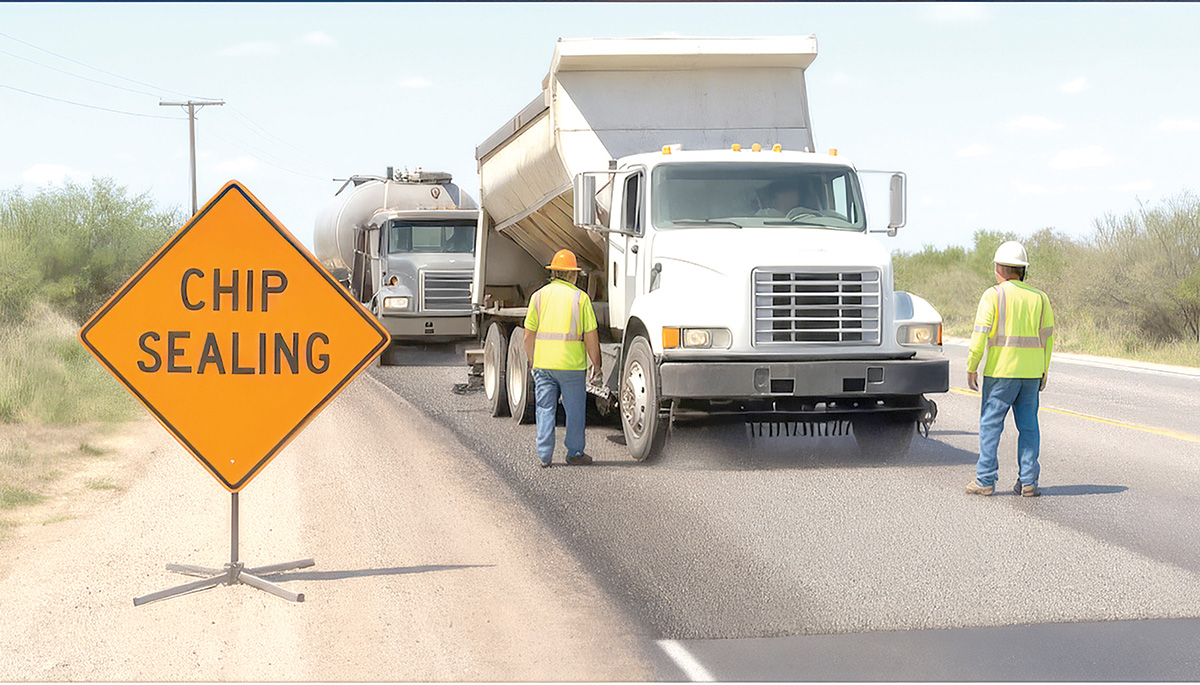
Getting ahead is going to cost Goshen at least another $500,000 per year, according to the pavement report. The issue is not that Goshen is ignoring maintenance, Battista said: Chip and seal rounds have been consistent.
“The roads are degrading, despite the chip seals,” he said. “They’re degrading slower than if you did nothing, but they’re degrading, nonetheless.
“It’s not just Goshen. It’s everywhere,” Battista said. “I’m working in Winchester, which is way worse than Goshen in terms of their road conditions, and that’s what we’re finding.”
THE WHO AND THE HOW
The Nutmeg State has 21,430 miles of paved roads: 19% maintained by the CTDOT and the other 81% by municipalities, according to the Connecticut Society of Civil Engineers, affiliated with the American Society of Civil Engineers (ASCE).
Like most states, Connecticut services infrastructure largely via its gas tax of 25 cents per gallon, last raised in 2001. That’s below the national average of about 33 cents per gallon, industry watchdogs say.
Electric cars and more fuel-efficient autos are reducing that revenue source, the ASCE reported. Motor vehicle receipts, driver licenses, and federal transportation grants can’t make up the difference to help fund day-to-day highway operations.
ROUGH ROAD SURFACES
Most Northwest Hills communities have road systems showing similar wear and tear, according to data from the most recent years available.
There were 74.4% of roads statewide in good shape and the other 25.6% judged “poor” as of June 2024, the Connecticut Department of Transportation (CTDOT) estimated. In CTDOT District 4, which encompasses Northwest Connecticut, pavement conditions for the 1,100 road miles the Department maintains, were graded at 73.5% “good,” 24.8% “fair,” and 1.7% “poor,” according to a 2024 report, the most recent available.
WHAT’S DRIVING COSTS?
The expense of road construction and maintenance hinges largely on materials and labor costs. CTDOT reports materials are about 50-60% and labor is between 30-45% of most project price tags. Equipment, trucking, site preparation, base work, and other needs make up the rest.
Materials costs are up across the board, CTDOT reports. East Coast market asphalt prices, for example, were about $545 per standard ton in January and about $678 per standard ton in August. Diesel fuel at $2.24 per gallon in January was up to about $4.06 by August. The price for reinforcing steel is up by about 10 cents per pound this year.
As to labor, the biggest threat to infrastructure upgrades is a shortage of workers, Pew reported. Connecticut faces the same substantial skilled labor shortfalls most of the U.S. and world are experiencing.
Pew researchers also cite factors including administrative red tape to explain the spiking cost of maintaining infrastructure across the nation.
The rising costs add up. Overall baseline state pavement replacement values were near $109 per square yard in 2022, CTDOT reported, and about $122 per square yard last year by comparison, an 11% increase.
INDUSTRY IMPROVEMENTS
Advances in technology help fuel longer lasting infrastructure, according to the University of Connecticut (UCONN). Many new methods in asphalt paving bring both economic and environmental benefits.
One option is sustainable paving called Stone Matrix Asphalt (SMA), which uses polymer modified asphalt binder as a self-healing material, so the asphalt automatically repairs micro-cracks before they expand, according to UCONN’s Connecticut Transportation Institute (CTI). This means the pavement can last 10-15 years, about five years longer than traditional asphalt, CTDOT reported.
Permeable or porous pavement is another way to go, as it allows rain and snowmelt to pass through, easing runoff volume and filtering some pollutants, according to UCONN. Examples include cast-in-place concrete grids, modular concrete, or plastic lattice, and supplies including cobbles and natural stone.
Recycled materials have entered the pavement market, too, as many high-quality asphalt mixes incorporate recycled plastic and rubber, CTI reported. These can offer improved durability and reduce landfill waste at the same time.
STEPPING UP TO THE CHALLENGE
Town leaders in the Northwest Corner are addressing infrastructure needs, primarily via a boost in spending.
Over the summer, for example, Waterbury officials announced several investments in roads, sidewalks, drainage improvements, and other projects.
"This year's $10 million paving program nearly doubles last year's investment,” Waterbury Mayor Paul K. Pernerewski, Jr. said in a June 17 press release.
Battista and Garret Harlow, Goshen’s Public Works Department Supervisor, recommend another look at pavement deterioration expectations and a new way to predict gradual degradation on roads that receive regular preventive maintenance.
“It’s a big expense,” Battista said of continuous pavement upkeep. “The computer models are indicating we need to be spending more than we are and we think that’s absolutely true.”
That boost is what Pew found the entire nation needs. A July report this year that followed up on its February findings presented a new metric that calculates funding gaps as states address maintenance and repair of roads and bridges.
“Most states face long-term funding gaps, with only a few states poised to make sustained progress,” the think tank reported. “Many still need to meaningfully increase planned spending to satisfy maintenance requirements.
“Roadway maintenance funding challenges exist along a continuum, enabling policymakers to calibrate their investments, while also providing an early warning of possible future problems to support long-term planning,” Pew’s report stated.