New Year, New Chapter in Long Fight Over CT’s Utility Regulator

Marissa Gillett is the chair of the Public Utilities Regulatory Authority. Yehyun Kim/ctmirror.org
Connecticut’s regulated monopolies have never seen anyone quite like Marissa P. Gillett. Neither have her colleagues at the Public Utilities Regulatory Authority, where she is the undisputed boss. Nor have the legislators who relied on her counsel as they toughened the framework for how electric, gas and water rates are to be set.
As chair, Gillett has taken charge of every docket, applied stricter scrutiny over everything from employee schedules to utility lobbying expenses, and rattled Wall Street with a self-described “adversarial” approach that a colleague likened to a punishment in Gillett’s first-rate case.
In that instance, not only did PURA deny a $35 million increase sought by the Aquarion Water Company, it also ordered a $2 million reduction that left the Eversource subsidiary apoplectic. The cut, coming after a decade of rising costs, all but announced there’s a new sheriff in town.
Legislators overseeing energy policy heap fulsome praise, calling her a welcome disrupter. PURA’s other commissioners, John W. Betkoski III and Michael A. Caron, have clashed with Gillett while praising her intellect and work ethic. PURA employees complain of, among other things, too much change, too fast. About three dozen have left since her arrival at the 68-person agency in 2019.
As for Eversource and Avangrid, the multi-state corporations whose subsidiaries deliver electricity, natural gas and water in Connecticut, they speak carefully of Gillett, at least when they are not suing her agency. But Gov. Ned Lamont, whose administration recruited her from Maryland to bring an outsider’s perspective to an authority long dominated by Connecticut politicians, is certain of their opinion.
“I talk to everybody all the time, including the CEOs, and they have not been understated on that subject,” Lamont said.They want her gone.
Lamont said there was no explicit demand that he deny reappointment when Gillett’s first term expires in March. None was necessary. Lamont said the utilities make their point by regularly complaining of a hostile regulatory environment.
The more pressing question: What does Lamont want?
In Gillett, he hired a change agent, an experienced regulatory lawyer who has insisted on a greater distance from the regulated utilities. Now Lamont has to weigh his tolerance for change against the crescendoing complaints that Connecticut has become a bad place for utilities to invest.
Does he think Gillett is on the right course in trying to control the high cost of electricity? Or is Lamont, who acknowledges consulting with Wall Street about PURA’s impact on utility investment, concerned that she is discouraging the regulated monopolies from seeking capital to modernize?
There is little doubt he intends to retain Gillett. He speaks well of her, and a governor bowing to utilities’ desires to remove an unfriendly regulator would be awkward, if not politically unpalatable.
But he still can remake PURA around Gillett. Betkoski and Caron are serving on terms that expired last year and can be replaced whenever Lamont desires. And state law allows him to expand the authority from three to five members — the option he says he is most likely to pursue.
Lamont said he already has spoken to potential nominees who would bring a national perspective. Somewhat inscrutably, he spoke of wanting both a degree of “continuity” and fresh perspectives.
But to what end? If the governor wishes to recalibrate PURA’s approach under Gillett, he has not publicly given a clear sense of direction or degree. On Wall Street, there was speculation last summer of Gillett’s departure, possibly due to Lamont’s reluctance to replace either Caron or Betkoski.
“Look, I think Marissa is really good. I think she has more analytical professional skills in that job than most other states” have, said Lamont, who nonetheless acknowledged suggesting a less prosecutorial stance to her and a more collegial attitude to all three.
But Lamont’s bottom line is this: “I think we need her at this really complex time.”
Complex, indeed.
The expansion of PURA would be one more variable at an extraordinary time for utility regulation in Connecticut, beginning with the ill-concealed hostility between Gillett and the state’s two largest public utilities, tension among the three commissioners, poor morale among some long-time employees and concerns that the electric grid will not be ready for a transition to an auto market dominated by electric vehicles.
The state also is at a critical phase in the gradual shift mandated by the General Assembly and Lamont to performance-based regulation, modifying the century-old approach of allowing utilities to recover their cost of service and earn a reasonable return on capital investments.
By late August, PURA hopes to have finalized the standards, rewards and penalties under performance-based regulation. For the two electric utilities, the system will base compensation, at least in part, on how well Eversource and Avangrid do in keeping the lights on, not just on how much they spend.
On Jan. 11, a judge is scheduled to hear arguments on Aquarion’s challenge to the rate reduction, one of at least two cases before the Superior Court and one before the state Supreme Court that could affirm or limit PURA’s aggressive oversight of performance and expenses under Gillett.
The challenge by Aquarion, the region’s largest private water company when Eversource purchased it for $1.675 billion in 2017, reads like a declaration of war on Gillett, attacking not only the decision engineered by the chair but the manner in which it was reached. A judge has stayed the rate reduction, a rare action that gives Aquarion hope of prevailing.
Aquarion says the rate reduction was “irreparably flawed and cannot stand” and is replete with “example after example of unlawful decision making, ignored legal requirements and standards, baseless rationales and/or reliance on extra-record evidence. The cumulative effect of these errors is a decision that is unprecedented both in terms of its punitive nature and damaging impacts.”
It was one of several factors that led Regulatory Research Associates, a Standard & Poor’s unit that tracks regulated markets, to downgrade Connecticut’s regulatory environment in August to the second-lowest of its nine grades. To investors, that says Connecticut’s regulatory environment is one of the worst in the U.S.
‘The Worst for Who?’
At the center of it all is Gillett, an engineer and lawyer intent on transforming PURA and its relationship with the state’s monopolies, inflicting chronic agita on the regulated and those officials and staff who regulate them. Conflict and change have been constant, all of it deliberate.
“Typically, there isn’t so much focus on one regulator. It’s very abnormal,” said Shahriar Pourreza, an analyst who tracks Eversource and other utility stocks for Guggenheim Partners. “But this one regulator has publicly shown a lot of disdain towards the utility that she governs, that she regulates, and that has generated a lot of investor angst.”
Pourreza said Gillett has all but dared Eversource, which has 4.4 million electric, natural gas and water customers in Connecticut, Massachusetts and New Hampshire, to invest where it can get a better return. He has shared his concern directly with Lamont, whom he described as inquisitive and “asking the right questions.”
The stock price of Eversource fell 27% in 2023; Avangrid was off by 25%. Both saw offshore wind investments go sour in 2023, but Pourreza said Connecticut’s regulatory environment was a heavier drag on Eversource, the supplier of electricity to all but 20 of the state’s 169 cities and towns. Pourreza blamed the dreaded D-word — disruption.
“Do investors like disruption in utilities? No, we don’t. It’s not the tech industry, where we like disruptions. We like consistency and stability, because it’s utilities, right?” Pourreza said. “Just think about all the 401(k) investors, retirement investors. As you get older in life, you’re investing in utilities for that dividend.”
Gillett is unapologetic. Early on the job, Gillett concluded that PURA was an agency in need of reform and the state’s utilities required closer monitoring, a conclusion reaffirmed in 2020 after a slow restoration of power after a massive blackout caused by Tropical Storm Isaias.
“I think people either love me or hate me, but either way I think people should feel like they know what they’re getting. That’s my goal,” Gillett said. “I don’t want it to be a question of insincerity or second guessing what I’m trying to get at. I’m trying to be transparent.”
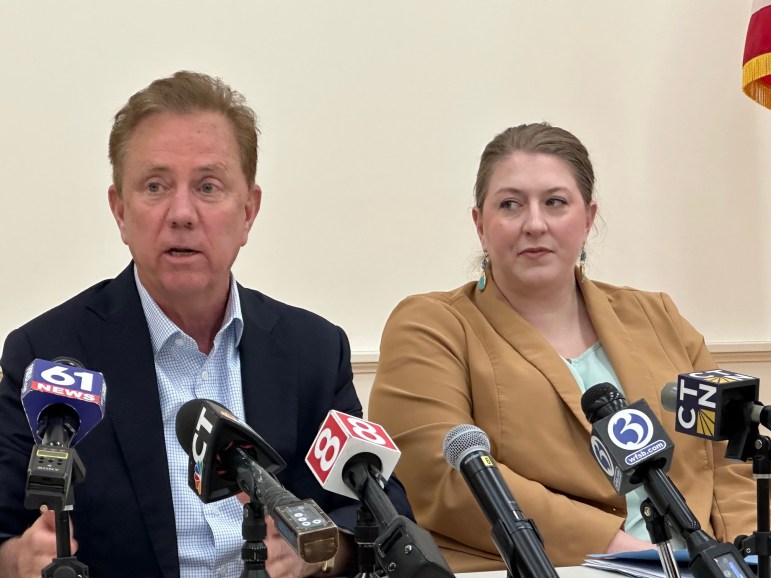 Marissa P. Gillett, the state’s chief utility regulator, watches Gov. Ned Lamont field questions about a new approach to regulation in April. MARK PAZNIOKAS / CTMIRROR.ORG
Caron, 63, has been a commissioner for more than 11 years; Betkoski, 71, was appointed 26 years ago. They are past presidents of the National Association of Regulatory Utility Commissioners, Caron completing his term last year.
“I appreciate they’ve been there for a while,” Lamont said. “I also appreciate that they bring some experience to the table.”
Caron and Betkoski acknowledged tensions with Gillett but insist they can work together, a message the governor clearly wants to hear. “I’ve had five chairmen. Everybody has their different style,” Betkoski said. Notwithstanding dissents on some cases, he said, “We get along.”
As far as Gillett’s aggressive take on rates, Caron said ultimately the commissioners are tasked with carrying out policy set by the General Assembly in statute.
“And they have made it clear, ‘We want more rigorous attention paid to what the ratepayers are getting.’ And the governor made it very clear he likes his disrupter,” Caron said. “But he wants somebody who’s had some experience to help guide the ship.”
Caron is a Republican who served 18 years in the House, from 1991 to 1999. Betkoski is a Democrat who served for a decade in the House.
Both utilities have employees with deep experience in Connecticut’s legislative and executive branches.
Jonathan Harris, an Eversource executive and former aide to Gov. Ned Lamont, chatted with Lamont after a press conference asserting the electric grid would be ready for a transition to electric vehicles. MARK PAZNIOKAS / CTMIRROR.ORG
Gillett is 36, the married mother of 6-year-old twins, a political independent and a rarity at PURA on two counts: She not only is a regulatory lawyer but a political outsider. Gillett worked for the Maryland Public Service Commission from 2011 until 2018.
David Pomerantz, the executive director of the Energy and Policy Institute, a watchdog group that monitors how utilities “deploy influence” and “capture regulators,” calls Gillett’s studied distance from the regulated community and her skeptical view of rate demands “a total breath of fresh air.”
John Erlinghauser of AARP has a similar view.
“Marissa was brought in to be a disrupter and upset the status quo,” Erlinghauser said. “It was always the same old thing. You know, the utilities would come in for a rate increase, and it would be some outrageous rate increase, and then somehow it always ended up splitting the difference, except there was never a serious examination of everything.”
In the Aquarion case, Gillett disallowed $4.9 million in expenses related to its merger with Eversource, concluding the merger benefitted shareholders and not ratepayers. She also disallowed legal and entertainment expenses.