VA Secretary Defends Proposed Budget, Murphy Calls It a “Band-Aid”
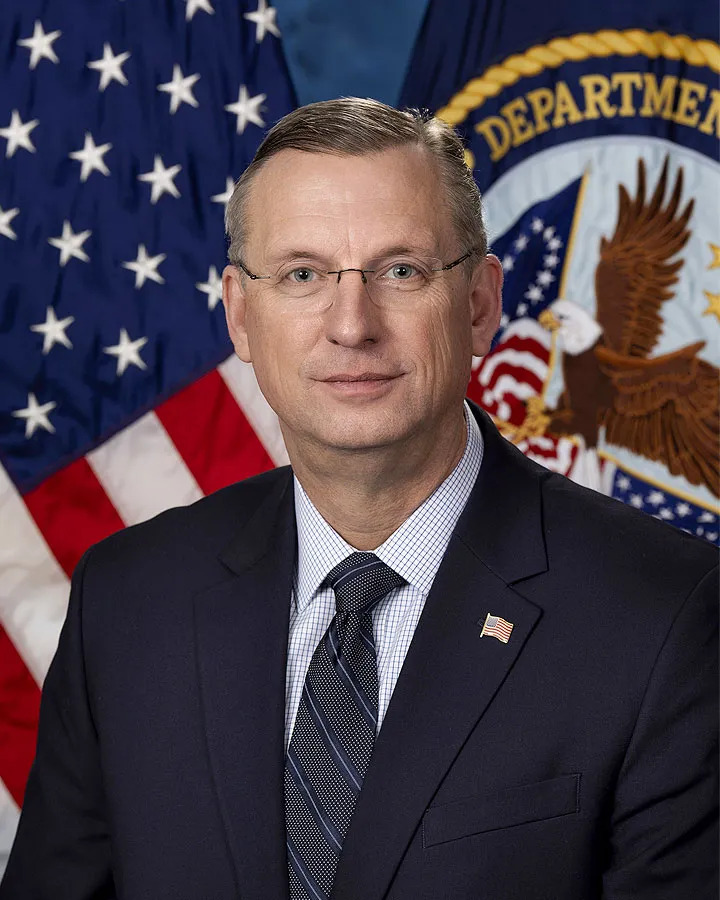
Doug Collins, United States Secretary of Veterans Affairs. Official Portrait 2025.
While Connecticut prepares to become the first state nationwide to offer free public bus service to veterans under its newly passed budget, Washington lawmakers are holding hearings and debating another veteran concern, the Department of Veterans Affairs’ FY2027 proposed budget.
The VA is “making sure resources go where they need to go,” VA Secretary Doug Collins told a Senate Appropriations Committee panel on April 30.
Collins, who started an initiative to reform the department earlier this year, has been making the rounds in and out of Washington to promote the budget. He said he has been to 32 states and visited about 50 hospitals, and even more clinics to “get a handle in managing this department.” He was expected to testify before the House Appropriations Committee in May.
“We took a hard look at the department — its structure, staffing, contracts and processes — and made common-sense changes to refocus VA on its core mission:
serving veterans,” Collins told the Military Construction and Veterans’ Affairs Subcommittee panel. This means, he said, protecting mission-critical roles such as doctors, nurses and claims processors and eliminating duplicative contracts, while reducing “unnecessary layers of bureaucracy that slow down care and decision-making.”
He listed a number of VA’s achievements in the last year including a 70% reduction, to 77,000, in the disability claims backlog; and the successful re-launch of the EHR system rollout at four Michigan hospitals. The Biden administration paused the rollout in 2023 after encountering tech and other problems with the system.
While lawmakers were generally supportive of those efforts, some on both sides of the aisle questioned Collins about the sufficiency of current VA staffing given the VA’s elimination of nearly 30,000 jobs last year, as well as plans to close certain underperforming clinics.
A report by the VA Office of Inspector General last summer found that Veterans Health Administration facilities reported a total of 4,434 severe occupational staffing shortages — a 50% increase from FY2024. Some 94% of these facilities also reported severe doctor shortages, and 79% reported severe nursing professional shortages.
The VA’s FY2027 proposal seeks to boost overall staffing by 6,183, adding 354 doctors, 1,115 registered nurses and 402 nurse assistants.
Collins blamed the Biden administration for increasing VA staffing at hospitals by 14% despite patient encounters increasing only 6%. “VA is not a federal jobs program, but in the past it acted like one,” he said.
However, he said, the VA is actively recruiting “hundreds of people at every one of our hospitals and we will continue to do so.” He added that one of the challenges is that the government cannot compete with the private sector when it comes to physicians’ salaries. “[Physicians] are not going to come to the VA if they can make $400,000 down the street, and we’re seeing that a lot,” he said.
Sen. Jon Ossoff (D-GA), ranking subcommittee member, welcomed the proposed budget’s “robust” overall investments in care and services but said he has some concerns including that the proposal appears to allow for a decrease from last year in the number of doctors and registered nurses. He also raised concerns over the proposed 17.2% increase in outsourced, privatized care and only a 2% increase in direct care accounts.
Privatized care allows veterans to use the VA’s Community Care Network to see non-VA doctors, while direct care refers to VA medical professionals at government-owned VA facilities.
When asked recently about the VA’s workforce reduction, Sen. Chris Murphy (D-CT), who sits on the Appropriations Committee but is not part of the subcommittee, told The Goshen News in a statement that the proposed budget was a “band aid proposal.”
He said it will not “solve the problems Trump caused by slashing 30,000 jobs from the VA and unleashing DOGE chaos on veterans’ care. It’s a slap in the face to the men and women who bravely served our country and are now facing even more severe staffing shortages and longer wait times when they try to get health care.”
In January, Sen. Richard Blumenthal (D-CT), ranking member of the Senate Veterans’ Affairs Committee, released a report on what he called the Trump administration’s “draconian directives and cuts on veterans.” The report found historic staffing losses at the VA that resulted in severe workforce shortages, increased wait times for mental health care, and veterans’ care and benefits being put at risk due to the administration’s harmful policies.
Part of the White House’s $2.2 trillion budget proposal for the federal government, the VA’s proposal is $488.2 billion, a 7.7% increase over the FY2026 level. It allocates $144.7 billion in discretionary funding and $337.7 billion in mandatory funding. If passed in its current form, it would include $121 billion for medical care and $54.6 billion for the mandatory Cost of War Toxic Exposures Fund. It also would provide $1.4 billion for specialized health programs focused on women veterans.
Other funding for programs and services includes $257.2 billion for veterans receiving disability compensation and retirement pensions; $3.7 billion for suicide prevention and treatment; and $3.5 billion for homeless assistance programs. A total of $16 billion would be allocated for non-medical programs including $3.4 billion to continue implementation of the VA’s Electronic Health Record (EHR) modernization initiative.