DEEP Leaves Local Leaders Fending for Themselves
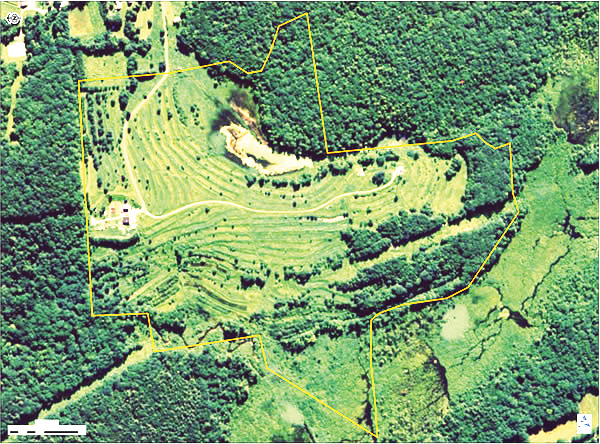
Aerial view of WLSD Plant and settling fields/Courtesy WLSD
GOSHEN – The Department of Energy and Environmental Protection (DEEP) safeguards Connecticut’s natural resources via many routes, but Northwest Hills residents may wonder if it’s more of a speed bump when it comes to regulatory duties.
There are examples across the region of time-consuming detours local governmental bodies are taking to work with DEEP.
In Goshen, the Woodridge Lake Sewer District (WLSD) Board has worked with state environmental officials for decades to finalize a long-term solution for its sewer system’s viability. That work continues.
“We have been unable to achieve DEEP agreement regarding our position,” the Woodridge Lake Sewer District (WLSD) Board wrote to taxpayers in May. “The Board remains frustrated by the lack of progress.”
Separately, Town of Washington leaders have worked for more than two years to buy the approximately 11 acres that include the former Washington Landfill and land leased by the town for its current transfer station. The sale isn’t complete yet.
“Unfortunately, we’re having some issues with DEEP about testing the landfill area,” Selectman Jay Hubelbank said in a Dec. 11, 2024, Sustainability Committee meeting. “We are forced to have to do some more testing.”
Meanwhile, the Town of Goshen’s Inland Wetlands and Water Courses Commission (IWWC) is getting up to speed on what it’s like to work with DEEP. Images taken by neighbors who allege illegal
dumping at Ike’s Auto Body, 225 North Goshen Road, were shared with the agency late last year. A DEEP spokesman, however, later said evidence fell short of triggering state regulatory action.
“DEEP determined this was a Town matter,” according to IWWC meeting minutes from the Commissions July 2 session.
Since the State says it can’t act, members of the IWWC say they will, but that’s not usually an option for local government.
DECADES OF EBB AND FLOW
The Woodridge Lake area’s quest for a long-term sewer system solution has been peppered with detours linked to DEEP, formerly the Department of Environmental Protection (DEP), which issued its first operational groundwater discharge permit in 1974 for the WLSD’s collection system, sewage treatment plant, and disposal fields.
The 385-acre man-made lake was developed in the late 1960s with a private, 1,700-acre recreational community, according to the Woodridge Lake Property Owners’ Association. There are 785 one-acre lots that now make up the Woodridge Lake community.
Most homes in Goshen use subsurface sewage disposal (septic) systems, and that was the initial plan for Woodridge Lake. But the Connecticut State Department of Public Health nixed the method due to the soil type, steep slopes, ledge, and the lake being in a public watershed, according to district history. The WLSD was formed in 1970 to protect water quality for the Woodridge Lake area, the district website states, and the Sewer Authority Board was created to operate and maintain the system.
The state initially approved a design for processing up to 200,000 gallons per day but in 1989 limited flow via a consent order due to capacity concerns, according to WLSD and DEP documents. The consent order also directed water quality monitoring and construction of a distribution system to uniformly spread effluent, which is liquid wastewater, from the treatment plant.
Over the years, studies have recommended either upgrading the existing infrastructure and disposal fields or piping wastewater to Torrington or Litchfield.
“Our wastewater plant is now 55 years old and well beyond its normal useful life, and unexpected repairs are virtually certain at any time,” the board wrote to taxpayers in May.
‘STUFF WE CAN CONTROL’
In 2024, the state legislature approved a $3 million grant to help the district “resolve the long-standing issues with DEEP,” the Board wrote in its 2025 letter to taxpayers. Supporters State Rep. Maria Horn, D-Salisbury, and State Sen. Stephen Harding, R-Brookfield, plan to request more funding when DEEP approves a WLSD plan.
“We have spent the last five years waiting for the Litchfield WPCA to begin developing its long-term plan, which the Department of Energy & Environmental Protection (DEEP) wants us to be a part of,” the District Board stated in its May letter to taxpayers this year. “If the Litchfield pipeline project or an on-site solution moves forward, the District will submit financial plans for a taxpayer vote to authorize funding before the project is initiated.”
WLSD President Jim Mersfelder, a 15-year member of the Board and now its President, said waiting on DEEP for a green light on a sewer system solution hasn’t left operations idle. “We’re doing what we need to do, stuff that we can control,” Mersfelder said.
DEEP’S WEED
Elsewhere in Goshen, DEEP’s Waste Engineering and Enforcement Division (WEED) has been called upon to examine activities at Ike’s Auto Body on North Goshen Road. Movement on the issue, however, has only occurred due to local efforts.
The Town of Goshen issued a cease-and-desist order in December. Then-Enforcement Officer Spencer Musselman reported scrap building materials appeared to be going into a large pit dug at the site. The new Ike’s property owner has denied doing any dumping, according to Musselman.
A show cause hearing was set for December regarding “illegal dumping of refuse and other materials within a regulated wetlands upland review area,” according to the IWWC. It was continued to January, then February, and on July 2, the IWWC again delayed the session, with meeting minutes stating no one representing Ike’s attended.
First Selectman Seth Breakell has said it was DEEP that directed the Town to issue the cease-and-desist order for local enforcement. He told The Goshen News in December, “It’s their case at this point.” Breakell could not be reached for comment for this story.
WEED and DEEP determined in a springtime investigation there wasn’t enough evidence of a violation on the Ike’s property to prompt state action. Further proof would be needed, agency officials said.
This month, the Town of Goshen’s IWWC confirmed its regulatory authority regarding the land and got behind the wheel to steer action on the issue. The panel discussed its next moves at its July 2 session, according to meeting minutes.
“The Commission did acknowledge that they now have something that says there are wetlands within 150 feet of the reported disposal area,” the minutes state. IWWC and town leaders, plus the town attorney, are working on a plan to address the issue, “and want to make sure they do this correctly.”
“The public that attended were encouraged to contact DEEP and their political reps as well since DEEP determined this was a Town matter,” the minutes state.
VETTED BY DEEP
The Town of Washington has been in talks since at least 2024 to purchase its former landfill from private owners for $250,000. Washington now leases land there for its transfer station. First Selectman James Brinton told Environmental Council members in early December 2024 the purchase price will “pay for itself” in about eight years.
This year, a May groundwater sampling report on the former landfill at 57 Clark Road off Nettleton Hollow, delivered to the Town on June 5 and posted on its website July 20, found several contaminants on site. The town used the landfill for municipal solid waste from about 1970 to 1995, according to GO Environmental, which did the groundwater testing this year.
DEEP’s regulations require groundwater to be remediated and surface water to be protected against infiltration of contaminants that originate in groundwater at the landfill. GO Environmental recommended its report be submitted to DEEP and that the agency be consulted to ensure its proposed recommendations for future monitoring will meet DEEP requirements.
Gabrielle Frigon, director of WEED, said in a January email that all relevant regulatory obligations as to the landfill will become the town’s when it purchases the land.
“Any activities on the landfill will have to be vetted by DEEP and potentially approved by the commissioner,” she said.
“DEEP is requiring that we do these groundwater well water tests. Last ones done were in 2012,” First Selectman Brinton said in September 2025.
Selectman Hubelbank expressed frustration at the red tape.
“And even if they test negative, we still have to clean it up,” he said. “It just shows you the craziness with the State government … on something they’re requiring us to do for something we have to take care of anyway. It makes no sense.”
Clarity from DEEP is an elusive proposition. Ray Turri, WLSD board member and vice-chairman for IWWC in Goshen, told The Goshen News in 2024 he had met with state officials in Hartford previously to offer and seek cooperation on long-term solution but didn’t receive a clear path forward from DEEP.
Officials at DEEP offered no new comment on these matters for this story by press time despite repeated attempts to reach them.
“We’re holding. We’re on hold,” Mersfelder told The Goshen News on July 20 regarding the sewer system at Woodridge Lake. “We haven’t heard anything back from them.”