How Connecticut changed during COVID

A COVID screener gets ready for a nasal swab testing in Hartford in December 2021. Yehyun Kim / ctmirror.org
On May 10, exactly three years and two months after Gov. Ned Lamont declared a public health emergency in response to the COVID-19 pandemic, he declared it over.
But that doesn’t mean life got a hard reset to the beginning of 2020.
COVID-19 caused a cascade of changes to what we used to call “normal” in Connecticut and beyond. Some of those changes came and went, but some have persisted. The “new normal” is now just normal.
Conventional wisdom was that everyone started drinking heavily during those first few months of locked-down isolation, that students (and teachers) abandoned their lessons, that people were driving like maniacs set loose and that nothing was ever going to be the same.
The data collected over the last three years shows that some of the conventional wisdom was spot-on and some was decidedly not, that some things have recovered and others have a ways to go.
CT is becoming more entrepreneurial
From 2019 until the pandemic was declared, Connecticut had an average of 2,817 new business applications per month, according to U.S. Census data.
And there wasn’t a lot of variation. The lowest monthly amount was just under 2,500 and the amount never went higher than 2,980. A month after the pandemic was declared, however, applications fell to just below 2,000, the lowest amount in almost two decades. But then, applications spiked — and rested at a level far above pre-pandemic numbers. July 2020 and January 2021 broke all-time highs, with more than 4,300 new business applications in each of the months.
Following that peak, the numbers stabilized to a monthly amount higher than the pre-pandemic average. The number of monthly applications after January 2021 until March 2023 remained no lower than 3,500 and had an average of 3,812 applications per month.
Two key players in the business and startup industries say that layoffs, financial support and the increased ability to connect online are partially driving the rise in entrepreneurship.
"The uptick in everyone's awareness and ability to navigate connecting online has opened up possibilities of having a more online-based business," said Sarah Bodley, executive director at reSET, an organization dedicatated to supporting social entreprenuership through incubators, accelerators and mentorship. "I see yoga teachers that are all of a sudden teaching people all over the world because they can do that in Zoom."
Bodley also said that the job market is causing some people to start their own business.
"We've had more people who have been laid off, or furloughed, or couldn't find work during COVID, who thought, 'Well I've been sitting on this idea for a while, maybe now is the time.' That's the story I've heard multiple times from folks," said Bodley.
Chris DiPentima, president and chief executive officer of the Connecticut Business and Industry Association, said that a declining workforce with people retiring or people leaving their jobs is also driving the rise.
"COVID made us all reflect a little about, 'Are we doing something that we love? Are we doing something that we think is meaningful and impactful on the world?" said DiPentima.
He notes that the state budget surplus along federal relief money was able to provide financial support to entrepreneurial organizations such as CT Innovations, innovation hubs and the Women's Business Development Council.
"There's more support out there to start a business than there ever has been in Connecticut," said DiPentima.
However, he emphasized that the state's workforce shortage needs to be addressed.
"As more and more businesses start up, we need more people. It's going to be tougher and tougher to find talent. And so that's even more reason why we need to focus on growing the population and increasing the labor participation rate, because we've got to make sure that these new companies that start up have the workforce that they want," DiPentima said.
Baby boom
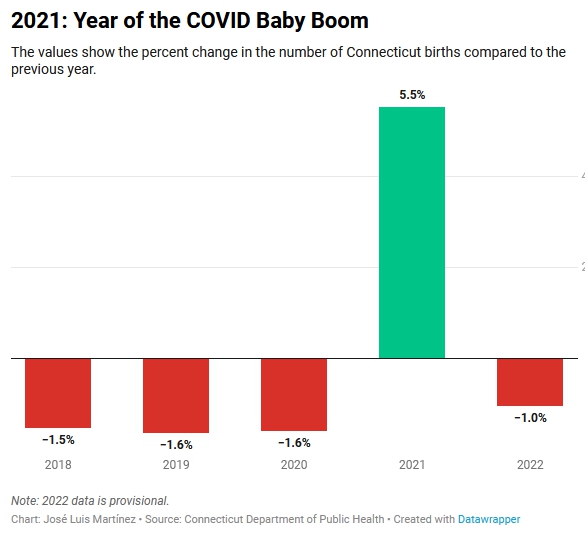
Data from the Office of Vital Records show that in 2021, the number of babies born in Connecticut was the highest in years at 36,929, a 5.5% increase from 2020.
The 5.5% increase is an outlier, given that for many years before it, the number of births had been declining by up to 1.6% per year. Even in 2022, the number of babies born decreased again by 1%. August boasted the most babies born in 2021, at 3,425, about nine months after November and December of 2020. A study of national data by the National Bureau of Economic Research found similar trends nationwide and attribute the baby boom to remote work.
"Many women saw little income loss and even income gains due to pandemic support programs. Yet fertility gains were concentrated in groups such as college-educated women who saw drastic reductions in the opportunity cost of having a child, when they were able to work from home and work schedules became more flexible," reads the study. "The reduction in opportunity costs may have been greatest for childless women, who did not have to cope with the simultaneous loss of day care and schooling opportunities for older children."
The city of Waterbury had the highest resident birth rate in 2021, at 14.2 per 1,000 residents, followed by Stamford, Hartford, Killingly and Manchester. Of the babies in the state in that year, 53% were born to white mothers, while over a quarter were born to Hispanic mothers. The age group with the biggest boom was the 30 to 34-year-old group, accounting for 37% of all births in Connecticut. The top baby names in Connecticut for male-born babies in 2021 are Noah and Liam. For female-born babies, it’s Olivia and Charlotte.
More people working from home
Weeks into the pandemic as businesses were ordered to close and social distancing became the norm, some workers were forced to work from home for months, even as some pandemic-related restrictions were lifted and some companies ordered their workers back into the office. But has that trend remained?
U.S. Census estimates show that the number of people working from home almost doubled since 2019, from just under 94,000 to over 186,000 in 2021, the most recent year with yearly data available. Remote workers made up 10% of the state’s working population in the state in 2021. Those commuting in personal vehicles still made up the majority of the workforce, 81.7% in 2021, but their numbers dropped 5%, from almost 154,000 to 146,000. The number of people commuting via public transportation also decreased by 17.4%. Since the data is as of 2021, it doesn’t take into account the entire effect of the Omicron variant surge in 2022 and restriction relaxations later in the year. 2022 Census estimates will be released later this year.
The rise in remote work is creating rippling effects across cities. Downtowns are bustling less and office spaces are becoming vacant, creating concerns among city officials. In turn, money is being poured into urban revival projects, office spaces are being repurposed and some companies are either luring or demanding that workers come back. Whether the rise in remote working continues is an unanswered question, as a fine line continues to develop between worker demands for hybrid or remote work and businesses wanting their employees back in the office.
Over a fifth of students are chronically absent from school
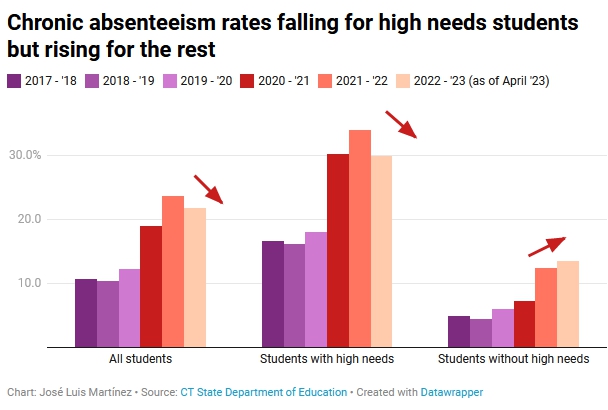
While students and teachers were thrust into remote learning in the second half of the 2019-2020 school year, worries emerged about student attendance and retention while they were at home. Turns out, the worries were justified. Chronic absenteeism rates, where a student misses 10% or greater of the total number of days enrolled in the school year for any reason, for the current school year remains far above pre-pandemic levels, according to state data.
The CT Mirror reported in January that total rates had increased in the current school year due to the “triple threat health issue,” which includes COVID-19, the flu and RSV (respiratory syncytial virus). However, in January, data for the current school year was only available up to December. Recently released April data signals an overall decrease in the current school year. The total student chronic absenteeism rate was 21.8% in the 2022-23 school year as of April, down from 23.7% the previous year, but far from the 12.2% rate from the 2019-20 school year.
The reversal can be attributed to the chronic absentee rate dropping for students with high needs, who make up 50.8% of the student population in the state. High needs students are English learners, those with free and reduced-price lunch, those experiencing homelessness and those with a disability. Their rates dropped from 34% to 29.8%. Meanwhile, rates for students without high needs saw a narrower increase than the January data showed, going from 12% in the school year starting in 2021 to 14% in the current school year.
Are we drinking more?
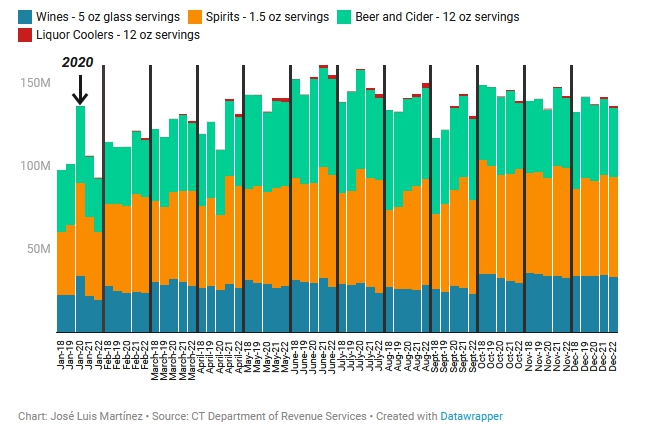
A few months into the pandemic, sales of beer and cider from wholesalers had their busiest summer yet. Over 16.5 million gallons of beer and cider were purchased by retailers from June to August in 2020, higher than the two previous summers. That’s the equivalent to over 176.5 million 12-ounce bottles of beer or cider.
Spirits also had a busy summer. July 2020 saw more wholesale sales of spirits of any month, at more than 806,000 gallons, the equivalent of 68.8 million 1.5-ounce servings. The total for the entire summer of 2020, 188.1 million 1.5-ounce servings, was also a above previous summers but was still outpaced by purchases in the 2021 summer, the equivalent of 194.8 million drinks, and again in the summer of 2022, where the equivalent of more than 198,000 drinks were sold to retailers.
Wines, whose wholesale purchases usually peak from October to December, continued a decline as the pandemic went on. In that three-month period in 2018 and 2019, the equivalent amount of wine purchased by retailers hovered just above 104 million 5-ounce servings. However, in 2020, it dropped to 100 million servings, until it declined to 95 million servings in 2022.
Deaths in Connecticut
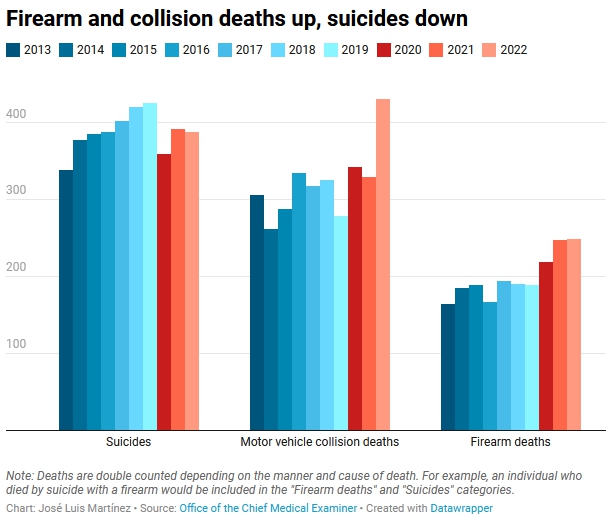
Certain types of deaths in the state had record increases and decreases, according to data from the Office of the Chief Medical Examiner. In 2020, there were 359 suicides, down 16% from the year before and the lowest since 2014. The drop is notable given that previous years were showing a rising trend, increasing by 1% to 4%. The following year, however, saw a 9% increase to 392 suicides in 2021, pushing numbers up, but still below pre-pandemic levels.
Motor vehicle collision deaths saw a record increase of 23% in 2020 and 31% in 2022, the highest since 2016, where they had only increased by 16%. In December 2022, the CT Mirror reported that the rise can be attributed to speeding cars, people driving under the influence of drugs or alcohol, pandemic-related stressors and fewer tickets being handed out.
Another rise in deaths was also seen regarding firearms. In 2020 and 2021, firearm deaths increased by 15% and 13%, respectively. A smaller 1% increase in 2022 pushed the number of deaths to a high of 249.