Communities Spar Over Wakesurfing Ordinances
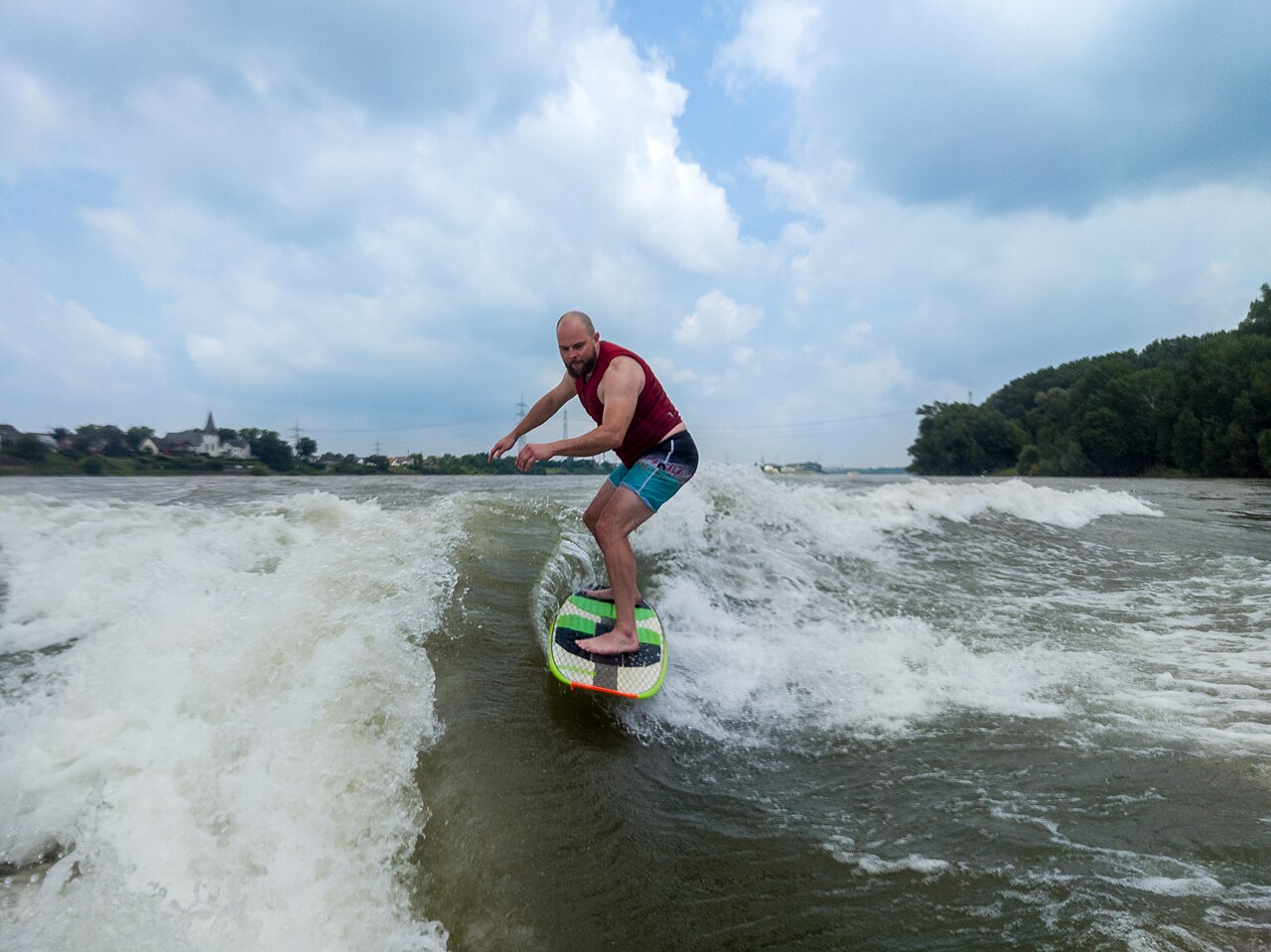
By Matti Blume - Own work, CC BY-SA 4.0, https://commons.wikimedia.org/w/index.php?curid=150158714
It’s a sport that’s growing in popularity but has many people at odds over its regulation. Wakesurfing has already been banned on Lake Waramaug, and many other lake communities are watching closely as a lawsuit progresses through the courts over the prohibition.
Connecticut isn’t alone in tackling the issue: States like Minnesota and Michigan have issued guidelines related to wakeboats, too.
Wakesurfing, unlike wakeboarding and waterskiing, has not only lakefront residents but also environmentalists concerned. A recently published study by DEEP (Department of Energy and Environmental Protection) claims wakeboats and wakesurfing have the potential to damage shorelines and infrastructure, and also aquatic habitats. There have also been complaints by residents and others who use the lakes that they have been put in danger by the boats.
Washington First Selectman James Brinton said the study and resulting ordinance came after complaints from residents about three years ago. “It was three or four years ago; we had people coming to the Board of Selectman meetings. People were concerned about swimmers, kayakers, and canoers and things like that; so, we looked more into it.” Brinton said they hired a company out of Wisconsin to study the issue, and based on the information they provided, an ordinance was drafted, working with DEEP. He said the ordinance was hashed over during numerous informational meetings and adopted in July of 2025. “The ordinance was identical for all three towns, (Washington, Warren, and Kent) and all three passed it overwhelmingly,” Brinton said, adding, “It’s important to note it doesn’t ban or prohibit [wake]boats. It just prohibits that activity.”
The sport has the boats creating an artificial wake so participants can surf behind the craft. Unlike waterskiing and wakeboarding, the surfer does not need to use a tow rope but is untethered in performing a variety of jumps and tricks while surfing. According to the wakeboat study, the boats are also configured differently than a typical motorboat. In order to generate the waves needed for the sport of wakesurfing, the boats “are designed with a specialized hull design and an internal ballast system filled with water to increase the vessel’s displacement, which in turn creates a bigger wake behind the vessel as it moves forward through the water.” The motors are also specifically designed to displace more water and create a larger wake.
Typical boat motors have a propeller that pushes water behind the boat to move it forward. Wakeboats have a propeller that has a fixed downward angle, pushing the boat upward and forward. The effect is a hydroplane situation. “What the ordinance prohibits is the use of those boats in that mode, that wakeboard, wakesurf mode,” said Brinton, explaining the boats can still be used for tubing, fishing, or cruising. “They just can’t do that activity that causes these large waves.”
In January, DEEP published a statement on its decision declining “to issue a declaratory ruling,” allowing the restrictions to remain in place. In its declaration, DEEP explained that it had received petitions from Kent, Warren, and Washington which were adopted some six months earlier, regulating the sport. Ordinances in all three towns were approved by DEEP in October of 2025. A month later, the Waramaug Friends for Common Sense Regulation, Inc. (LWF) filed a legal challenge, asking DEEP to reverse its approval of the wakesurfing ban on the lake.
The group’s president, Keith Angell, said he wants to see common sense regulation that will be effective for all of Connecticut’s inland lakes. He said the current ban on Lake Waramaug is based on flawed reporting and lacks scientific evidence, adding, “DEEP filed a motion to dismiss [the petition] and the court denied that motion just a few weeks ago because they believe our arguments have merit.” Attorneys for LWF, Pullman & Comley, stated in the legal filing, “The Ordinance is arbitrary, unreasonable, unnecessarily restrictive and inimical to uniformity throughout the state.” The group claims there is no evidence to support the ban, or that wakesurfing has “caused a material environmental harm nor any recordable safety incidents on Lake Waramaug.” Angell said not only has Connecticut been looking at the issue but so have other states who have decided not to regulate wakesurfing but instead are instituting distance from shore regulations.
“Fourteen states have decided, have looked at this issue, studied the science, and concluded that 200 feet is scientifically sound,” he said. DEEP is supporting the ordinance that keeps wakeboats from creating artificial waves in any part of the lake. “DEEP did its own study, that included that reasonable distance from shore regulation,” he added, saying, “It’s so simple and easy that this is really a waste of taxpayers’ money, I believe. To have a few people who are up in arms rule the roost when the issue has been decided over and over again by science, it’s common sense.”
In the petition, LWF clarifies the differences between wakeboats and other watercraft, stating that the optimal speed for wakeboats is about 10 mph, or about 8.7 knots, whereas jet skis can hit speeds of 40-70 mph, and boats that pull tethered tubes or water skiers operate at between 10 and 35 mph.
According to ATX Surf Boats’ and Malibu Boats’ websites, the boats can top out at up to 36 mph, though slower speeds are necessary to create the wake or surfable waves.
Angell said he is still looking for a statewide regulation that follows the science and that can be the same for every lake in the state. “Let’s be fair,” he said, “Let’s be science-based, and let’s not listen to the fear mongering.”
Data shows wakeboats should operate in 20 feet of water or greater when in surfing mode to minimize impacts on the lakebed, according to a 2025 University of Minnesota (UMN) Twin Cities Healthy Waters Initiative study. The research was conducted at the St. Anthony Falls Laboratory by the College of Science and Engineering’s Applied Research and Engineering team.
Seven recreational powerboats, including a wakeboat with an inboard engine, were used in the research. “This study did not look at the longterm impacts to the lake by recreational boating activity,” researchers wrote.
Another analysis recommends that wakeboats operate at least 500 feet from docks or the shoreline, regardless of water depth, according to July 2023 recommendations from the Michigan Department of Natural Resources (MDNR). This study suggests wakesurfing boats operate in at least 15 feet of water and offers the guidelines as “voluntary best operating practices in support of the continued use of wake boats while minimizing the effects on natural resources.”
The report for the MDNR aimed to “review the current state of knowledge regarding the effects of wakeboat activity on natural resources” to inform Michigan’s stance on the issue.
“The operation of wake boats in a manner that creates large waves can erode shorelines and resuspend sediments and is an emerging threat to natural resources in inland lakes,” the MDNR states.
First Selectman Brinton argued that the local regulations were overwhelmingly approved by the residents of the three towns, but Angell claimed the opposite. “We polled lake owners, the people who are most impacted. There are 300 properties on Lake Waramaug, and 80 percent of them believe that the 200-foot distance, as DEEP concluded in their study, is adequate and they believe it’s the right thing to do.” Angell also disputed the Selectman’s claim that it was overwhelmingly approved.
“People who have never been on the lake say, oh, we should save the lake. Well, of course, everybody wants to save the lake, but they didn’t give an option of 200 feet, which is what the state and the science shows.”
A group supporting the ban issued a notice to supporters on Oct. 16, saying they don’t believe that DEEP will overturn the ban. Kelly Williams and Bruce Birenbaum, co-chairs of the Protect Lake Waramaug: Coalition to Ban Wake Surfing Association, wrote that they will continue to defend the ban. They contradict Angell’s claim that LWF has made inroads in court. “They argued initially that the ordinance should be overturned because DEEP made an administrative error in not granting a hearing on the ordinance when they submitted a petition and signatures to DEEP in June,” the memo stated.
While DEEP was initially named as defendant, Protect Lake Waramaug has joined the suit. In their October update, Williams and Birenbaum stated, “We asked to be a party to the lawsuit in order to ensure that the voice of our community is heard in the suit, and that we receive notice of, and can appear at, all stages of the proceedings.”
A spokesman for DEEP could not comment on the filing, referring instead to the Attorney General’s office. He also noted legislators will not be acting on any statewide referendum until at least January or February because they are in recess at this time.