U.S. Medical Leaders Sound Alarm on Healthcare System Crisis, Identify Priorities to Spur Action
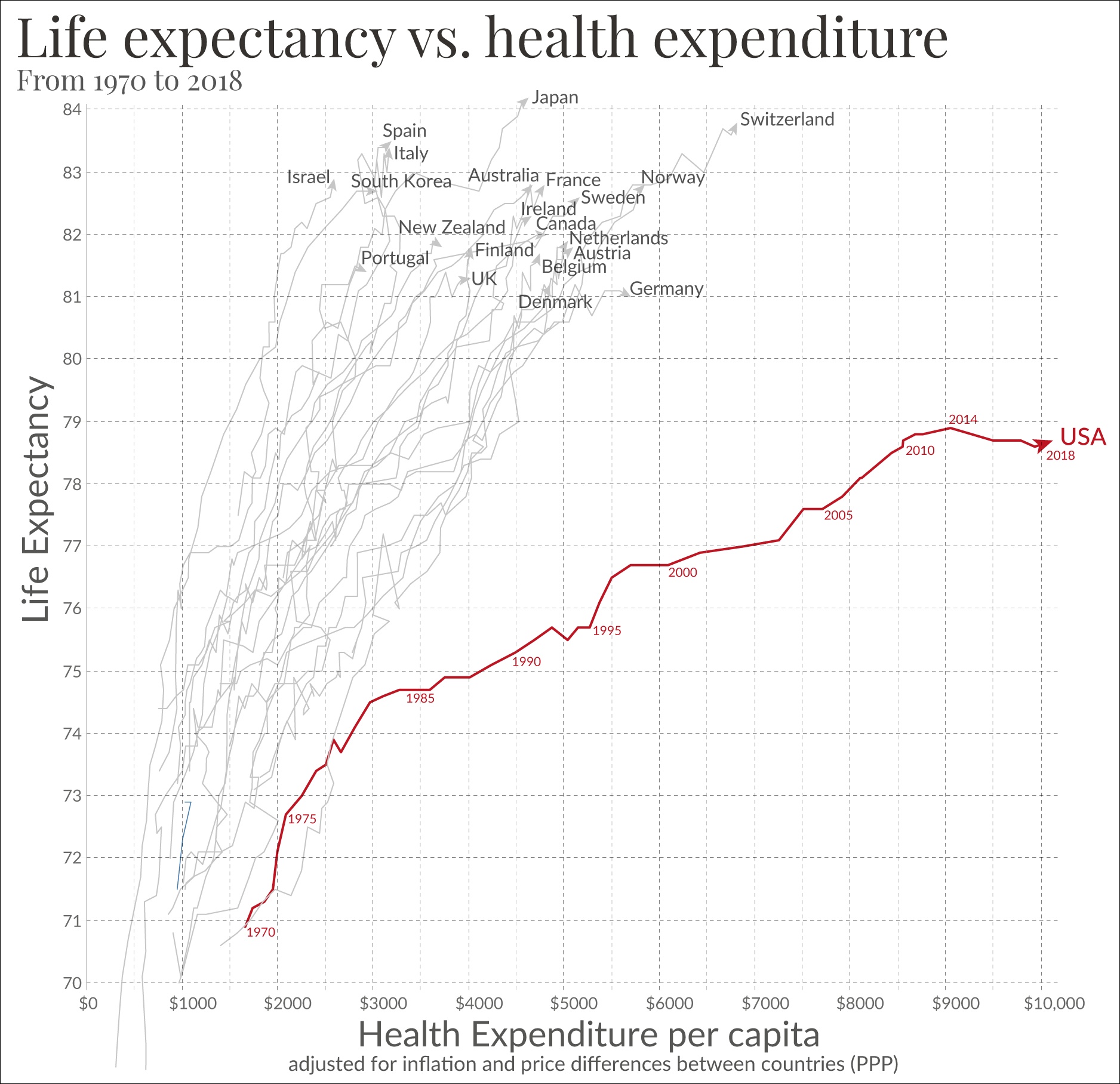
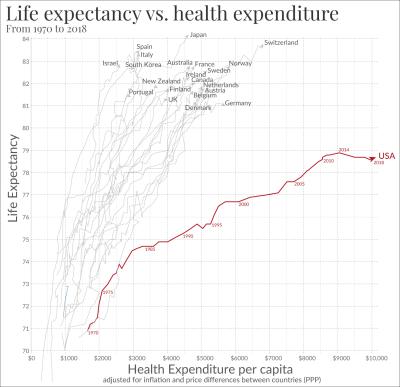
By Max Roser - Link between health spending and life expectancy: US is an outlier (archive link). May 26, 2017. By Max Roser at Our World in Data.
The American healthcare system is facing dynamic and ever-changing operating and financial environments due to rising medical costs, heavy patient demands, and complex regulatory compliance standards.
Last spring, the American Heart Association (AHA) released a Presidential Advisory on Healthcare Affordability warning that the expense of healthcare in the United States has reached crisis levels.
The AHA Presidential Advisory was formed by an extensive research and writing group process that included interviews and listening sessions conducted with key stakeholders — including patients, clinicians, payer representatives, employer representatives, health system leaders, and public health experts — to better understand the drivers and consequences of the healthcare affordability crisis and shape a framework to guide solutions.
Total healthcare spending nationwide is approaching $5 trillion annually and is projected to consume 20% of the nation’s gross domestic product within the next decade, according to the advisory, placing unsustainable pressure on patients, families, and the healthcare system.
“Healthcare affordability is one of the defining challenges of our time,” said Dhruv S. Kazi, M.D., M.S., AHA volunteer and writing committee chair. Kazi also is director of the Cardiac Critical Care Unit at Beth Israel Deaconess Medical Center and Associate Professor at Harvard Medical School in Boston.
American Medical Association (AMA) Board of Trustees member Dr. Scott Ferguson, MD, FACR, a diagnostic radiologist in West Memphis, Arkansas, raised red flags in 2025 about a range of challenges threatening patient care and physician sustainability in the U.S. healthcare system. Speaking to Health Exec magazine at the AMA House of Delegates meeting, Ferguson highlighted urgent concerns including Medicare payment reform, immigration hurdles for foreign-trained physicians, prior authorization burdens, cuts to public health research, and what he called the unchecked growth of private equity in medicine.
“The dominant issue today is Medicare and Medicaid payments,” Ferguson said. “Over the past 20 years we have had a 33% decline in payments, and our medical costs continue to rise.
“We need some type of inflationary update to cover the cost to our staff, our supplies, all our rents,” he said. “All of those things continue to escalate, and we have nothing to balance them off.”
Outdated budget neutrality rules and the lack of an inflationary update mechanism are crippling physician practices, especially in rural and underserved areas, according to Ferguson. “It's access for our patients, not just physicians being able to keep their doors open. We're losing. We have a physician shortage and we're continuing to lose people," he said.
The overall number of Americans without health insurance increased by fewer than 1 million from 2024 to 2025, according to a report from the Centers for Disease Control (CDC) National Center for Health Statistics (NCHS). The report, "Health Insurance Coverage: Early Release of Estimates from the National Health Interview Survey, 2025," shows that 11.6% of working-age Americans (those ages 18–64) did not have health insurance in 2025. This percentage is unchanged since 2024 but is significantly lower than 13.5% in 2021, the CDC reported.
More warnings about healthcare system woes came via the New England Journal of Medicine (NEJM). Catalyst Innovations in Care Delivery is a peer-reviewed digital journal published by the NEJM Group, a division of the Massachusetts Medical Society, designed to share innovative, practical, and cost-effective solutions for transforming healthcare delivery.
A journal article published in Physicians Weekly said transforming the U.S. healthcare system demands coordinated progress across financing, care delivery, workforce development, and innovation infrastructure. Corresponding author Gillian Sanders Schmidler, PhD, and colleagues at the Duke-Margolis Institute for Health Policy synthesized insights from the 2025 Duke-Margolis Institute for Health Policy’s Fourth Annual Health Policy Conference and developed a road map for transforming the U.S. healthcare system through coordinated alignment across financing, care delivery, workforce strategy, and innovation infrastructure.
“Moving toward an accessible, effective health system requires coordinated action on multiple time horizons, with near-term steps to build momentum, intermediate reforms to institutionalize change, and long-term structural shifts to secure durable improvement,” the authors said.
They detailed short- (1-3 years), intermediate- (3-5 years), and long-term (5-10 and more years) priorities.
Short-term priorities
• Strengthen primary care payments
• Expand patient access to digital engagement tools
• Improve data sharing and reduce clinicians’ paperwork
• Launch targeted listening sessions with innovators
Intermediate-term priorities
• Implement new, value-based models for Medicaid and Medicare
• Integrate social determinants of health into risk adjustment
• Scale workforce apprenticeship programs in under-served and rural areas
Long-term priorities
• Modernize the Centers for Medicare & Medicaid Services (CMS) information technology infrastructure
• Establish national standards for a more resilient drug supply
• Redesign licensure and scope-of-practice policies
• Invest in population-level improvements in chronic disease prevention
“Healthcare transformation requires coordinated engagement across diverse sectors, each contributing essential expertise, authority, and infrastructure,” the authors wrote, noting that federal and state leaders, particularly those guiding CMS and Medicaid, shape payment models, scale new care approaches, and set the incentives that drive system performance.
The AHA Presidential Advisory said affordability cannot be addressed through cost cuts alone — strategic investments in the healthcare workforce, infrastructure, primary care, data, and public health also are necessary to improve outcomes while controlling long-term costs.
The AHA outlined five core principles to guide policymakers and stakeholders toward a more affordable and sustainable healthcare system.
• Access to high-quality care without financial hardship
• Minimal or no cost-sharing for high-value, cost-effective care, including preventive services
• Shared accountability across the healthcare ecosystem for advancing a more efficient, transparent, and cost-conscious healthcare system
• Strategic investments in the healthcare workforce, infrastructure and data
• Strengthen the public health infrastructure and address health inequities
“We at the American Heart Association believe everyone deserves access to quality health care without financial hardship,” said Nancy Brown, Chief Executive Officer of the American Heart Association. “Affordability is not just an economic issue — it is a health issue that directly affects lives.
“By laying out clear, evidence-based principles for action, we are doubling down on our commitment to advance policies and solutions that improve access to care, strengthen prevention, and build a more sustainable healthcare system,” Brown said.