CT’s 2023 legislative session has ended. What does that mean for you?
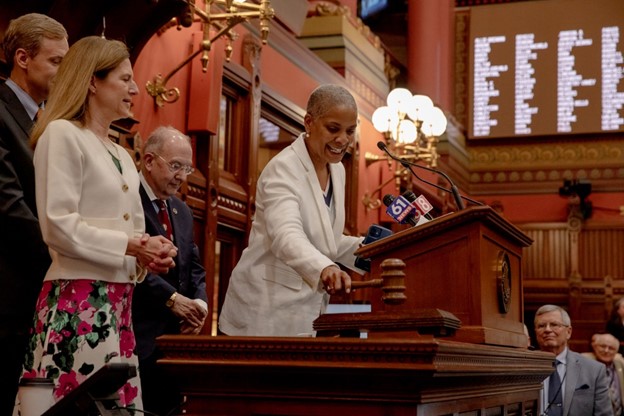
Secretary of State Stephanie Thomas bangs the gavel to officially close the legislative session a few minutes past midnight on June 8. Yehyun Kim / CT Mirror
The Connecticut General Assembly’s 2023 legislative session ended last week. Lawmakers introduced hundreds of bills, and around 330 were passed by both the House and the Senate.
Here’s a look at some of the bills likely to impact many Connecticut residents.
Traffic camera option for municipalities
Connecticut municipalities would have the option to use automated cameras to enforce speed limit and red light violations under a traffic safety bill that gained final passage.
According to House Bill 5917, the speed limit and red light cameras would be limited to school zones, defined pedestrian safety zones and other locations chosen by local officials and approved by the Office of State Traffic Administration.
Automated enforcement zones must be clearly marked, and speeders would have to be going at least 10 miles per hour over the limit to get an automated ticket.
Fines would be capped at $50 for a first offense and $75 for a second offense regardless of a violator’s recorded speed. The revenue would go to municipalities and must be used for traffic-related expenses.
Early voting/no-excuse absentee voting
The legislature approved two election measures, one bringing early voting to Connecticut and another that will ask voters by referendum in 2024 to authorize no-excuse absentee voting.
House Bill 5004 requires municipalities to offer 14 days of early voting in the general election in 2024, less for primaries and special elections. Ballots cast early will be sealed in envelopes not opened until Election Day.
An additional resolution scheduled a constitutional amendment referendum in 2024, the next statewide election. If approved, that would give the legislature discretion over absentee balloting — that is, voting by mail, rather than in-person at a polling site.
Income tax cut
The biennial budget adopted by the state legislature includes the first major cut in state income tax rates since the tax was enacted in 1991.
The budget specifically would reduce the two lowest marginal rates on the income tax. The 3% rate imposed on the first $10,000 earned by singles and the first $20,000 earned by couples would drop to 2%. The 5% rate imposed on the next $40,000 earned by singles and the next $80,000 by couples would drop to 4.5%.
The budget would begin to phase out the tax cut for singles earning more than $105,000 per year and for couples topping $210,000.
The rate changes are expected to save many middle-class households $300 to $500 per year in the 2024 tax year, for which returns are filed in the spring of 2025.
Tenant protections
An omnibus housing bill that gained final passage contains several measures designed to improve tenants’ rights in Connecticut.
The bill notably increases the amount municipalities are allowed to charge for code violations from $250 to $2,000, which officials hope will push landlords to improve sub-par rental housing.
It also requires that tenants be given a chance to walk through apartments before renting them and limits what landlords can charge for tenant screening reports. Tenants would have to get a copy of the screening report.
The bill also curbs what landlords can charge in late rent fees, would have the Department of Housing develop standard leases in English and Spanish, and would ban small landlords from discriminating against tenants based on their sexual orientation.
The bill would also have courts remove online eviction records within 30 days if the case is withdrawn, dismissed or a judge rules in favor of the tenant.
Access to contraception/Narcan
A wide-ranging bill would permit the sale of non-prescription drugs in vending machines, including emergency contraception, and allow pharmacists to prescribe hormonal birth control.
The measure, which has received final passage, would enable greater access to over-the-counter medications by making them available in special temperature-controlled vending machines throughout the state. Drug packages in the machines cannot exceed a five-day supply.
The proposal also lets pharmacists prescribe hormonal contraception. Pharmacists who are morally or ethically opposed to prescribing birth control must provide patients who request it with a list of the nearest pharmacies that may prescribe the drug.
Additionally, the bill requires pharmacists to give patients a list of pharmacies that dispense abortion pills if their own location does not have a supply on hand or if the pharmacist objects to providing it for moral or ethical reasons.
Additional Legislation Signed Into Law
Gun Bill
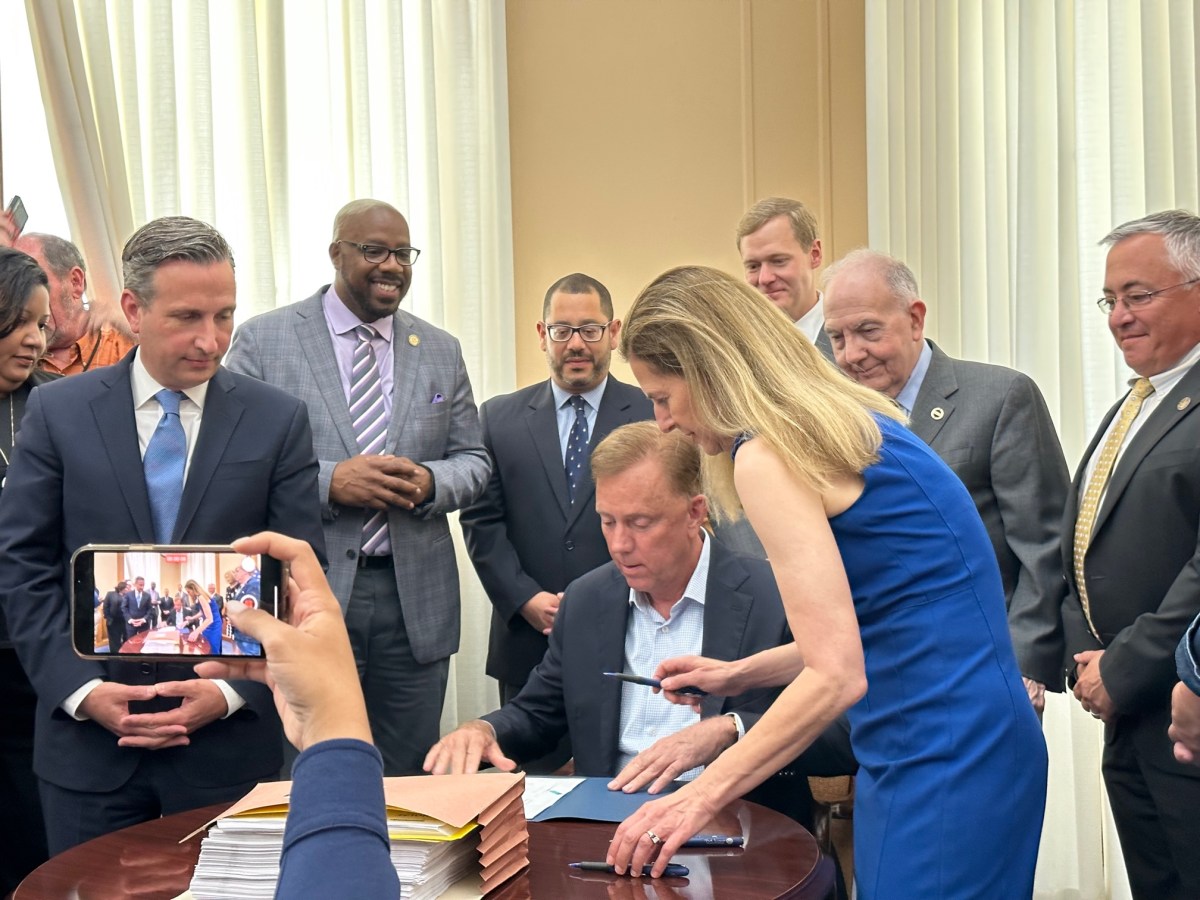
On June 6, Gov. Ned Lamont signed into law the first comprehensive update of Connecticut’s gun laws since the sweeping reforms enacted a decade ago in response to the mass shooting at Sandy Hook Elementary School. The bill updates several aspects of CT’s existing gun laws.
H.B. 6667 bans the open carry of firearms and strengthens rules for gun storage and reporting stolen firearms. It also expands a ban on AR-15s and other so-called assault weapons passed in 1993 and updated in 2013. AR-15s purchased prior to the bans still can be legally owned, if registered with the police. But the new law closed what proponents called a loophole that allowed the legal sale of now-banned weapons if manufactured prior to 1994. The legislation also further tightens restrictions on military-style weapons and high-capacity magazines that were largely banned after the Sandy Hook school shooting.
Additionally, the bill regulates the sale of body armor to civilians, generally limits the sale of handguns to three in any one month, increases training requirements for gun permit holders, and raises the minimum age to purchase a semiautomatic rifle from 18 to 21, the same threshold as handguns. The bill also bans the online sale of kits used to assemble “ghost guns,” firearms that have no serial number and are largely untraceable.
Limits to Deceptive, Coercive Police Interrogations
The bill deems an admission, confession or statement to police inadmissible or involuntary if it was obtained through deception or coercive interrogation tactics, such as depriving a person of their physical or mental health needs, or using or threatening physical force, the unlawful arrest of another individual or imposing unlawful penalties on the person under interrogation or another person.
The legislation carves out additional protections for minors by expanding the definition to include lying about evidence, misrepresenting the law and making false promises of leniency.
The bill’s passage coincides with ongoing legislative efforts by some to establish more accountability around the criminal legal system. A landmark police accountability bill signed into law during the summer of 2020 — frequently referenced in the three legislative sessions after — opened the door for people to, in the most egregious of circumstances, sue officers who violate their civil rights.
Child Marriage Ban
The bill raises the legal age for marriage in CT from 16 to 18.
Passed by the Legislature, Awaiting the Governor’s Signature
At the time of our publication deadline, these bills, passed by the Legislature, had not yet been signed into law by the Governor.
Accountability for Electric Companies
In a wide-ranging bill focusing on transparency, accountability and results for state utility customers, the Public Utilities Regulatory Authority will be required to conduct management audits of United Illuminating and Eversource. The law adds performance-based accountability standards, based on reliability, customer service and affordability.
Traffic Stops
The Act requires police officers to inform drivers of the reason for a traffic stop and encourages additional police officer training on de-escalation, use of force, customer service, diversity and bias.
“It codifies into law … what is already common courtesy out there,” said Rep. Pat Boyd, D-Brooklyn, co-chair of the legislature’s Public Safety and Security Committee. It is unclear how many of the state’s municipalities already require their officers to inform drivers of the reasoning for traffic stops.
By law, officers must already document the statutory reason for stopping a vehicle and use body-worn recording equipment during any interactions with the public. The bill doesn’t outline any consequences for officers who don’t comply with the new statute.
The majority of House Republicans didn’t support the bill, some of whom criticized it for the message they believe it sends to police.
“Police officers may say, ‘Hey, this is another thing that has been done to demoralize our profession,’ and I hate to see that,” said Rep. Greg Howard, R-Stonington, the top House Republican on the Public Safety and Security Committee.
Added Protections for Abortion Providers
Medical providers in Connecticut who face disciplinary action in other states for performing abortions could not be denied a license, have their license revoked, or be denied privileges here based solely on their out-of-state sanctions.
Proponents say the measure is an extension of efforts adopted last year to expand access to abortion and to protect those who provide or receive one. Legislation passed in 2022 made Connecticut a legal “safe harbor” state for those who travel here from another state to receive an abortion and the clinicians who perform them. It also expanded the type of providers who can perform first-trimester abortions to include nurse midwives, advanced practice registered nurses and physician assistants.