Back to Grass Roots: A Bi-Partisan Colloquy
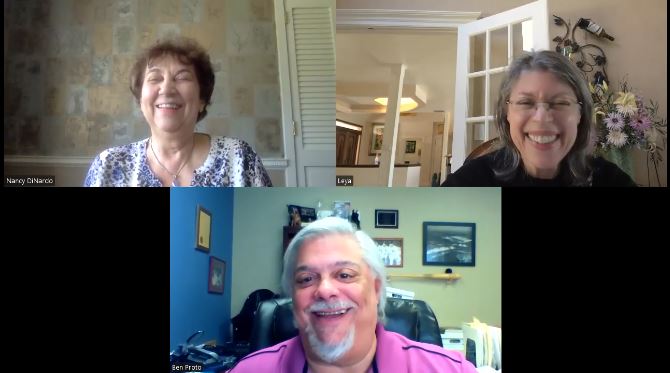
CT Democratic Chair Nancy DiNardo, CT Republican Chair Ben Proto, and Goshen News Publisher Leya Edison
NOTE: The full colloquy can be viewed in our video section.
On April 12th, State Republican Party Chair, Ben Proto, and State Democratic Party Chair, Nancy DiNardo, participated in a conversation with Goshen News publisher, Leya Edison, to discuss the common challenges faced by both parties. The following are excerpts from that conversation: (note- the full discussion can be found on the Goshen News website, GoshenNews.org.
Edison: In the last decade or so, there has been a significant percentage of the electorate that has dropped out of the two major parties. According to the Pew Research Center…. 34% of the electorate identify as Independent; 33% identify as Democrats and 29% as Republicans. Do we all see those as significant percentages?
DiNardo: I’m not surprised. I think a lot of people go unaffiliated. They often say “Independent”, but I correct them…..You’re unaffiliated…not independent. …. there’s an Independent Party. They may vote pretty regularly for one party or another, but they just don’t like to think that they’re connected to a party.”
Proto: I agree with Nancy. We’ve seen on both sides, not only in CT, but across the country, where voters have moved to a non-affiliated designation and Nancy’s right. I think that people don’t understand the difference between Independent and Unaffiliated. The other side of it is, when you look particularly at business people, oftentimes…don’t want to have a letter after their name....They are concerned that it might hurt their business.
DiNardo: I agree with Ben on that, particularly with business. “No, I can’t take a sign…then people in the other party, …won’t come and do business with me.”
Edison: As we’re all around the same age, I can go back to my youth when that wasn’t so. Growing up in the 50’s and 60’s, …post WWII people were very patriotic…they fought and died…for their country…Little things didn’t get in the way. The big thing was..we’re a democracy and we have two parties.” What do you think brought us to this, where it’s almost toxic to identify with either party. Do you see this as a growing trend?
Proto: It’s probably going to be a trend for a while. When we sit and talk about how to go about winning an election, … neither the Democrats nor the Republican candidates can win any election with just their base votes. They have to go…and figure out how to talk to unaffiliated voters and discuss issues that are of importance to them. And I think you’re gonna’ see that happen more and more, and I think, Leya, what you were saying, we all are products of that kind of 60’s growing up… I tell people all the time, I grew up here in the New Haven area… and I remember the Vietnam protests,… the Black Panther situation on the New Haven green,… the violence that occurred during the 60’s and into the early 70’s during Vietnam and the early post-Vietnam. And whenever people say to me “Oh, it’s never been this bad” I say “Really? We fought a Civil War 150 years ago where almost a million people died.” No, it has been this bad and worse.
For me, what has most changed the conversation and made it, as you say, “more toxic” is the advent of social media. And it has become way too easy for people to say things, … Anonymously, because the vast majority of people won’t put their name on a social media post, and… To say things behind a keyboard knowing that if they had said it to somebody’s face, they’d probably get punched in the mouth. So social media has made it much more convenient and easy for people to raise the rancor level and the vitriol level on discussions, and to make things far more personal than they were in the past… I think the advent of Fox and MSNBC and CNN who then take that and run with it, has really changed the dynamic of how we engage in conversation about politics and government.
DiNardo: I agree with Ben,… social media is a real big thing these days and it does get very personal…. And it has caused many problems, even in Connecticut, or … locally….when people are going after people where they wouldn’t have, (if) face-to-face. It’s a whole lot easier now and it has made a difference. I think it will continue… I don’t know how far it will go…. Social media has many pluses, but it obviously has caused many problems as well.
Proto: I like to look at things, that America… over the past 250 years, we have lurched far to the left, we have lurched far to the right…If you look at it as a pendulum, when swinging far left or far right, at the end of the day a pendulum spends most of its time somewhere in the middle. It takes a long time to get to the two extremes and then comes back immediately. So I think in the moment we’re living in an extreme situation. I am hopeful that history will repeat (itself) and the pendulum will start to swing back and put us back (in the middle) more, where it tends to spend most of its time.
Edison: It’s like the Reagan years when the Silent Majority was brought out, and are we still a country of mostly middle-leaning right, (or middle)- leaning left, as opposed to far right and far left, which is where I think we are right now. How do we get back to that incorporation of middle-right, middle-left, where we have more of a chance to agree on things?
“In the 60’s and the 50’s, you had the basic channels and they all reported basic news... CBS, NBC, ABC, they all reported basically the same stuff; that’s not the case anymore. You can get very right or left-leaning news.”
-Nancy DiNardo, CT Democratic Party State Chair
DiNardo: Obviously there are more people in the middle than the extremes, but again, it goes back to not only the social media, but Ben commented on it, but you have these different news [media] like Fox and MSNBC that are definitely leaning one way or the other and while they tend to report a lot of news, they tend to lean either Democratic or Republican,…and they just run with what they see… Before, in the 60’s and the 50’s, you had the basic channels and they all reported basic news... CBS, NBC, ABC, they all reported basically the same stuff, that’s not the case anymore. You can get very right or left-leaning news.
Edison: That’s true, but there’s been a big change in the law, and one of those changes has been that TV stations used to take on the expense of presenting news, …unaffiliated with any other interest. It was just presenting the news as it occurred. We remember Eric Sevareid and Walter Cronkite… they didn’t take sides, they just presented it. Now,…the 1996 vote in Congress allowed ownership of both sides of the media… before 1996 if you owned newspapers, you couldn’t own TV, then those lines were completely erased… Anyone could own anything and it didn’t matter how many of these you could (own), and it was for profit now… Because the TV stations said they couldn’t afford to do it and they left it up to Business. And as we all know, business has a motive. Business needs to make a profit and their profit (comes from)..getting people to watch. So what happens to the news, especially 24-hour news? “Do we put this on? This is so prurient. Let’s see what the public thinks.” And I think that has happened.
Proto: Last year I was out in Salt Lake City for the Republican National Committee meeting,… I was sitting in the hotel lobby…there was another gentleman sitting in the same little area and we started talking. He was a reporter for a major news outlet and we got to talking about that. And I said that reporters at one time (before the advent of the digital world) their job was to report the news. Their job was to tell you what happened, you know, the Who, What, Where, Why, and When. A reporter’s job today is to sell soap. It’s not to report the news… And he chuckled when I said that, but he agreed with me. When I say “to sell soap”, the goal today of any reporter of any news entity is to be first. And by being first, it means to be first digitally…The difference between a digital story and a story in a newspaper (that we grew up with) is that if the reporter got it wrong in the newspaper, we had to wait for another newspaper to come out for a correction. Today they can just go online and change it, and re-post the story. But they need to get you to click on the headline so that the story will pop up, and in addition to the story popping up, the banner for the dishwashing soap pops up, so you can buy the dishwashing soap, cause that’s how they make their money. They don’t make their money (by your) reading the news, they make their money on you clicking on an ad. And that’s dramatically changed how news is delivered to us.
Every year Nancy and I get invited to speak to a UCONN Law class…and I asked the students, “How many of you watch Channel 3, Channel 30, Channel 8, Channel 61?” None of them watch it at all. But they all watch Fox, CNN, MSNBC, CNBC. And I said to them “you understand that’s not news, that’s opinion, and you agreed with the opinion that’s about to be espoused before you even turned the TV on, that’s why you turned to that channel.” Almost none of them have ever read a newspaper by holding it in their hands, and every one of them got their news from either Tik Tok, Twitter, Pinterest, SnapChat, WhatsApp, some form of digital platform, that they got their news from. So it was somewhat disheartening to look at these folks who were predominantly millennial and Gen Z students who were relying heavily on what they were reading in 240 characters on Twitter or some other platform for news. Then they indicated, “well, you guys never explain your positions on things”, and I said “When I only get 7 seconds to grab your attention on your phone, to get you to last for another 30 seconds, it’s kind of hard to explain where we are on tax policy or on crime or on social issues in 10 seconds”.
DiNardo: I agree with Ben and it..(has) to be instant news because otherwise people will get off… They’re not looking for details. They’re just looking for something they can relate to and feel that (particular) way anyway.
Edison: I want to go back to a poll… this was the NPR poll in association with the Medill School of Journalism of Northwestern University… I want to share with you just four questions at a shot, to see how aligned non-voters are with voters on these four questions, and then as you get down to the very last questions in the poll you start to see a separation… I’ll read you the question and I’ll read you the percentage of the non-voters who agree with it and the percentage of the voters who agree with it.
“Traditional parties and politicians don’t care about people like me”. 80% of non-voters felt this way. 73% of voters felt this way.
“The mainstream media are more interested in making money than telling the truth.” I think we know the answer to that, 80% of non-voters said that, 72% of voters said that.
“The American economy is rigged to advantage the rich and powerful.” Non-voters 78(%), you see a little drop there in voters, they go down to 69(%), but they’re still not that far apart.
The last one:
“We should have a third major political party in addition to the Democrats and Republicans.” Non-voters say 64%, voters say 67%. Are they wrong?
Proto: If you had taken that poll in 1790 or 1890 or 1990 or 2010, I think it probably would have been very similar. Three-quarters of the people think that political parties don’t represent them. So who do we represent? 25% of the people? I think it would have been more telling to take that question and break it out. What percentage of Democrats think Republicans don’t represent them and what percentage of Republicans don’t think that Democrats represent them? And depending on what state you lived in you might get different results and different answers depending on who’s in charge… It would be interesting to see those questions asked in the 50’s. It might have been different during… World War II, when we were probably a more cohesive country and we had a common enemy. I think part of the problem is, we haven’t had in a very long time is a common enemy that we could get behind… I don’t mean that from a military or war perspective. But what is it that unites America behind other Americans? Oftentimes it’s the government and politics, and that has become toxic lately, and so the more toxic it becomes the less people believe that it supports them or represents them.
DiNardo: I agree with Ben. What I find fascinating…
Edison: You don’t seem like two different parties!
DiNardo: We agree too much…
Edison:…You see how America votes, not just your party.
DiNardo: What I find fascinating is these non-voters, and along those lines…it kind of still baffles me that more people vote in a Presidential election than in a state election and the least amount of people who vote are in a municipal election, except for the fact that you can go up to your Town Hall and knock on the door and talk to your mayor or First Selectman. Try knocking on the door of the White House, the Governor’s residence, and see where you’re going to get. And yet people think those elections are the most important elections. And yet… a lot of what affects them is really happening at the municipal level. But again, back to non-voters, it baffles me how there could be so many people who have no interest in any of it and yet know that it impacts on them. But they want nothing to do with it.
Edison: Well that’s a very good point and that leads to another one of the questions in this poll…:
“Voting in elections has little to do with the way that real decisions are made in our country”.
…which speaks to the lack of education as to what politics is all about, because 66% of non-voters agree with that statement, and 45% of voters agree…which tells me that Americans have forgotten what democracy is all about…Politics decides our lives…getting stopped on the street for not having a license on your dog, or committing a crime that was passed by a law in your state or in your federal government; These are all done by politics. And so I see the disconnect. Can you explain that? Am I on the right target that many Americans don’t understand their place in a democracy?
“One of the biggest failures in our country has been the media’s decision that local news is not important.”
-Ben Proto, CT Republican State Chair
Proto: I think that one of the biggest failures in our country has been the media’s decision that local news is not important. Back in the day,… Billy Joel had a great line that the good old days weren’t all that great and tomorrow ain’t as bad as it seems. But when your local newspaper –…(I grew up delivering the New Haven Register)…there was a reporter covering every town in the Greater New Haven area for the Register. Same thing with the Courant, they used to have a reporter that covered every town, the Waterbury Republican; you can go through all of these. That no longer exists. Now it’s very, very hard to find out what happened at your Town Council meeting last night, or your Planning & Zoning meeting last night, because they’ve dropped the local coverage. The weekly’s have become fewer and fewer and have been gobbled up by, you know, Hearst, or whatever…
Edison: Ridder…
Proto: See? Right? So I think the demise of local news has helped create the situation that you’re talking about, because it’s much harder to learn about that. You know the old saying that “All politics is local”, I don’t think (that) exists anymore. I think all politics is national… All you have to do is look at last year’s election and what was the single biggest issue that drove Americans last year in every state, in every state rep’s seat, and it was the issue of abortion… In Connecticut,…(it) isn’t really that much of an issue given the laws that we have on the books, and given where we’re at, but it became the dominating issue. Why? Because it was a national issue that then transcends…into local politics.
We will have, on our side this year, a municipal election. I guarantee you that we will have reporters who will ask a mayor candidate or a Board of Education candidate “Do you support Donald Trump?” Well I’m not sure that whether you support Donald Trump has anything to do with your ability to be a Planning & Zoning Commissioner or a member of the Board of Education. But we’ve made it a national issue.
Going back to that story I told you about the reporter I met out in Salt Lake City, I asked him a question. I said: “When was the last time that you wrote a story about a bill that was sponsored by Bernie Sanders and Ted Cruz and passed 93 to nothing?” He says “I’ve never written that story”. I go: “You cover Washington. Does that happen?”
He goes: “All the time”… (I said) Why? ‘Cause it doesn’t sell soap.
Edison: Right, exactly…
Proto: There’s a lot more that goes on. You can just look at a lot of what goes on in the Connecticut Legislature, I know it drives a lot of my base crazy, and it probably drives a lot of Nancy’s base crazy, when they sit there and go “Oh, you capitulate too much to the other side” or “You work too much with the other side” or “You compromise too much with the other side”. And you look at ‘em and you go “Politics is the art of compromise”.
DiNardo: …I find it fascinating that people don’t get involved more, as I said earlier, with the local politics, where they can make a difference. Yes, it’s always about national politics, and that’s true, they’re going to ask you who you support on a national level and it’s unfortunate, because it does impact on,… your dog license, or…things like that…People just don’t understand that. Once, I was with a bunch of people and I asked them… “Who is your local State Rep?” A lot of people don’t even know who their State Rep is. Some of them knew who their State Senator was, they could tell you the names of people you always see in the news, but they don’t know who’s representing them in Hartford, which is…
Edison: Sad, very sad… What I’d like to know, and perhaps we can tell people, educate people as to what they can do, because I would like to have us come back to (the reality of) “All politics is local”. Because those people who we put on those Boards, who we elect as First Selectmen and mayors, can be our next senators or our next governors or our next President. They have to start somewhere. And what better place to start than in your own hometown?
So how do people do that? How do people go out and look for candidates, of all ages of all types, to get them to run for these public offices?
DiNardo: Well, I smile, because as a Town Chair, and Ben could talk about this too, usually you have a candidate who’s willing to run for mayor or First Selectman, we have town clerks that ran in Trumbull, and Treasurer. But trying to get people to (run for)…our Board of Finance, or Town Council; I mean it’s difficult, and it’s really a matter of getting your town committee to reach out to people and ask people, and to do events. In Trumbull we have done a number of events as Democrats, but open it up to the public to come in and comment. We’ve done it with new voters…when I was there we invited new residents and new voters to come in and hear about what’s going on in the town, and some of those actually do end up signing up. But one time it was funny because we left voter registration stuff out, and the people who registered to vote, more of them registered as Republicans than they did as Democrats…So we were helping the Republican party. I was glad they all came out…
EDISON: I remember a time when serving your community in a political way was considered an honor. Let’s try to bring that back. I remember when a few people from a town committee would go out and make an appointment with people in the community who they thought were honest, intelligent; the best of what we had… (in our community) and say “Would you please be our candidate for da-da-da-da-da…?” Do you remember that time?
DiNardo: Oh yeah, sure…
Proto: Truthfully, I think that still happens at various levels. One of the biggest issues and problems of getting people to run for local offices, you know, while the participation level at the polls on Election Day for a municipal election is the lowest we have for any election, the participation level on personally attacking local officials on social media is at an all-time high. And you know, back in the day (and I still try to live by this rule and I know Nancy does as well) families were off-limits. Well families aren’t off limits anymore. People will attack your kids, will attack your spouse, they’ll attack your parents, and they’ll pick up the phone and call your employer and say “Hey, you know so-and-so said this on Facebook and they’re a crazy nut and they shouldn’t be working for you, and if they continue to work there I’m not gonna come and do business with you.” And people are losing their jobs because of votes they make on Town Councils or Boards of Education, and so it’s becoming harder and harder to find people who are willing to put up with that.
DiNardo: What I have found, at least when I was Town Chairman… but I always noticed that I could reach out to a guy and say “Hey, do you want to run for whatever..?” and they would basically say yes or no… But if I asked a woman they would say “Well, I have to think about it” and it was always amazing how a guy just did it and a woman would have to think about it, you know, there was more hesitancy. I think it’s gotten better in this day and age, but for a long time women were more hesitant to run than they are now.
Edison: I think also, we’re (waiting for)… civility to return. I think what Ben said was appropriate, that (candidates say) “Why should I put up with this?” “I’m not a saint, I’m a fellow citizen, so I’m trying to do a job the best I can.” So I think when approaching anybody who is in political office, civility has to come first. Why don’t we just back up a minute, form our question in a respectful way, and ask that question without being mean-spirited or condescending or attacking. And that’s what I think we’re trying to lean toward. Let’s see if we can bring the hot air down and bring up the cool thought, so that we can bring more people into this environment…to work together.
Proto: That would be great. Anything you can do to make that happen, Leya, I’m all in.
DiNardo: I was gonna say the same thing…
Edison: I just have three things that I want to ask you about… What are the requirements of candidates who come out to run for a position? I’ve listed three: Resumé and a bio, a background check, and a platform. What do you stand for, what do you want to do? Can you add or subtract to that?
DiNardo: Well, I can tell you a background check is good, because we’ve had a couple of times where people didn’t tell you that they had been arrested, or they had problems that came out during the campaign. But I tell people now to ask them “Is there anything you have done that, if it came out, you would be embarrassed?” But I think those are pretty basic, but quite honestly, at a local level you want to fill all of those positions, to make sure you have candidates to run, so you might not be as precise in all of that, other than making sure they have nothing to be embarrassed about. But you do tend to be more lenient in trying to get candidates to run. And you explain to them what the responsibilities are of the job so that they’re not blind-sided; how many days, how many meetings there are and things like that.
Proto: I agree with Nancy, and I think your three points are well-taken. At the local level I think you also want somebody who’s known in the community. It’s very hard to run for office, any office, when you don’t have some sort of a base to work from. That’s tremendously important. The other thing I tell people, and oftentimes we see people who want to start at the top (instead of) working their way up, that there’s a lot to be said for learning how to be on a Board of Finance or how to be on a Planning & Zoning Commission, or how to be on an Inland Wetlands Commission, or serve on a board or commission that doesn’t require (one) to be elected, it’s an appointed board. You know, go talk to your town committee, if you’re a Democrat or Republican cause they often recommend people for a position within a town and you can volunteer time on a town and do things. So I think having that base within your town or within your area is tremendously important. I agree with Nancy, you don’t want to have something in your background that’s going to embarrass you or your family. And you also have to have “buy-in” from your family. It’s very difficult to say “Yes, I’m gonna do this” when your wife or husband and your kids go “Are you out of your mind? Don’t do this, please!”
Edison: …So Nancy, I’ll let you make a closing statement and then we’ll go to Ben.
DiNardo: I think this is great, if people do pay attention and actually reach out to their local town committee and ask questions of them and see if they would like to get involved. Obviously, our reaching out to people doesn’t always work. So, hopefully, seeing this (article)…would certainly encourage people (if they have any questions about their local parties) to reach out to their town chairs.
Edison: What about the 34% who aren’t part of any town committee or don’t have access? How do they get involved?
DiNardo: Well obviously they can get on a third party line or they can come to the different town committees. We have, in the past, run people who have been unaffiliated on the Democratic line if they don’t want to be part of a party but they do want to seek an office, and I’m sure the Republicans have, too. We prefer that they be part of the party but if they’re willing to serve, especially at the local level, we’re more than willing to accept them.
Proto: The other thing is that if you want to get involved there’s ways of getting involved which don’t require you being a candidate. Whether you’re running for mayor or Planning & Zoning or Governor, you need people who are gonna help you during that campaign, who are gonna go knock on a door or make a phone call or put a sign up, you know, things like that. So there’s ways to get involved within the political world that don’t require you to be a candidate. In fact there’s more people involved in politics who don’t run for office than people who do run for office. So there’s ways of becoming involved that don’t require you to put your name on a ballot, not everybody wants to put their name on a ballot, but a lot of people do want to have an impact in their community and that’s a way to do it. Saying “I think “A” should be our next mayor and I’m gonna help “A” do that”. Whether they’re an unaffiliate, a Republican or a Democrat… if you’re an unaffiliate and you think the person who’s running as the Republican candidate for mayor should be the next mayor then go say “Hey, I want to help on your campaign”. Or if you think the Democrat should be the next member of the Board of Ed go say “Hey, I want to help on your campaign. What can I do? I know people, you know I’m involved in the Little League, I’m involved with the Kiwanis Club, or I’m involved with this organization. I know people, I can go talk to people for you. I really think you’re the right person.”
The more you do that, the more addictive this game becomes and the more you need the drug on a daily basis and then you end up like Nancy and (me), you’re looking for the next 12-step program.
Edison: Or you start a newspaper……