Federal Action Urged to Lower Electricity Costs
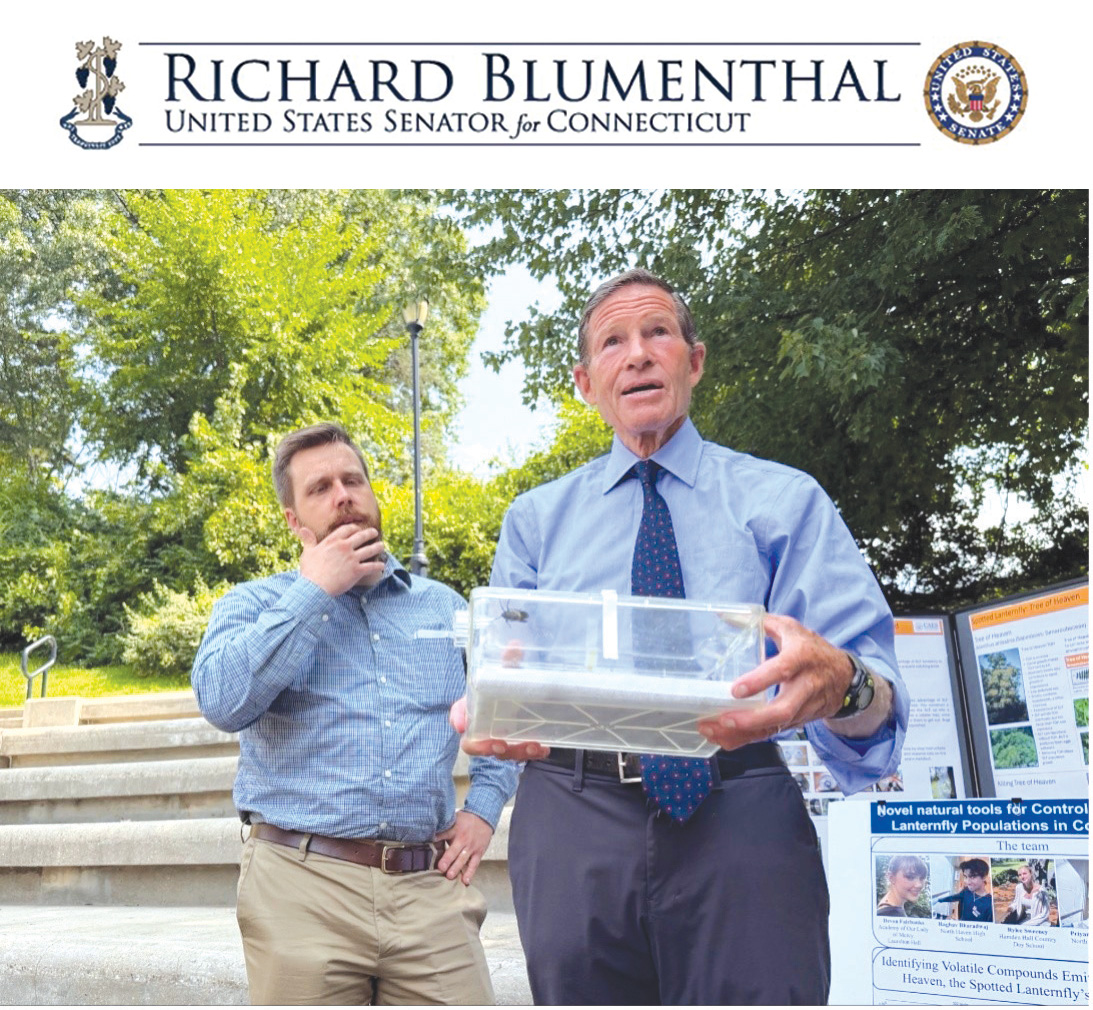
Connecticut U.S. Sen. Richard Blumenthal (right) holds up a box containing live spotted lanternflies Aug. 10 as state entomologist Jacob Ricker looks on in East Hartford. (Photo Courtesy of Sen. Blumenthal’s Office)
Week in Review: Aug. 14-21
Blumenthal introduced The Affordable Electricity Rates Act of 2026, a bill to require the Federal Energy Regulatory Commission (FERC) to consider affordability when setting transmission rates.
Transmission rates comprise 15 percent of your electricity bill, and Blumenthal’s legislation would prohibit any rate increases or charges that would increase overall electricity prices by over 5 percent.
“FERC has been anemic in its oversight of electricity costs. Connecticut consumers pay too much for electricity and federal authorities have done too little to protect them from rising costs by utility companies,” Blumenthal said.
Blumenthal’s bill would require FERC to consider whether a rate or charge is likely to result in retail electricity prices that are unaffordable for consumers and then prohibit any rate or charge that is unaffordable by considering it as not “just and reasonable” which is FERC’s current standard.
Blumenthal also wrote to FERC demanding strong oversight of asset condition projects, which are designed to improve equipment that’s part of the electrical grid. These are initiated at the discretion of the transmission company, such as Eversource, and they received a presumption from FERC that they are necessary.
In many cases, organizations like Eversource repair their infrastructure or replace full transmission lines when it isn’t needed, and consumers are left footing the bill, the senator said.
“For too long, transmission owners have exploited weak oversight to make unnecessary and expensive upgrades,” Blumenthal wrote to the agency. “Since 2018, transmission organizations in New England have spent twice the amount of money on asset condition projects as they have on new reliability projects — to the tune of $4.1 billion.
“The costs of these projects — which are initiated at the sole discretion of a transmission organization — are passed onto ratepayers across the entire ISO-NE region, with Connecticut residents paying 25% of all costs for projects that affect the regional grid, even for projects located in another state, like the X-178 transmission project,” Blumenthal wrote to the agency.
“Electricity consumers should be angry — not just at state regulators, but federal authorities for doing too little to protect them from financial abuse by electricity utilities,” he said. “I urge the Commission to act in the best interests of consumers and establish a mechanism for greater oversight of asset condition projects.”
FEMA Urged to Address
Staffing Shortages
Since the start of President Donald Trump’s second term, FEMA has lost 20 percent of its staff. A recent Government Accountability Office (GAO) report found that FEMA prioritized workforce reductions over ensuring that it had the staffing capacity to respond to current or future disasters.
Region 1, which serves Connecticut, lost 292 employees — 12% of its staff — just from workforce reduction efforts.
“Please provide, in writing, your plan to address the staffing cuts agency-wide, and especially in Region 1, and how you plan to ensure FEMA is fully prepared to support Americans this hurricane season and beyond,” Blumenthal wrote.
Answers Demanded
After “Stars and Stripes”
Staff Shakeup
Blumenthal, along with U.S. Senators Elizabeth Warren (D-MA) and Jeanne Shaheen (D-NH), senior members of the Senate Armed Services Committee, are demanding answers from the Department of Defense on the recent placement of an active duty servicemember to serve as a “deputy” to the publisher at Stars and Stripes, a newspaper that has maintained editorial independence since the Civil War.
Following the Department’s decision, Stars and Stripes publisher Max Lederer announced Aug. 18 he will retire after more than three decades at the newspaper, citing fundamental differences between his understanding of the value and mission of Stars and Stripes and the Department’s plans for the organization.
“The placement of an active-duty Public Affairs officer in the senior leadership of an organization whose credibility depends on its independence from the military chain of command raises serious questions,” the Senators wrote to Defense Secretary Pete Hegseth. “Mr. Lederer’s abrupt departure only heightens those concerns.”
Week in Review: Aug. 7-14
The U.S. Department of Health and Human Services requires Office of Refugee Resettlement (ORR) to adjudicate a completed sponsorship application of a parent, legal guardian, or close relative for an unaccompanied immigrant child within 10 days.
Despite this requirement, at least 24 children in Connecticut have languished in federal custody for lengthy periods of time, raising serious questions about why ORR is delaying reunification.
“At best, ORR is understaffed and woefully inept at carrying out its statutorily mandated functions in a timely fashion,” Blumenthal said. “At worst, and what mounting evidence points to, is that ORR’s goal has become detaining children indefinitely in a callous attempt to deter future migration.
“Either way, the best interests of children in ORR’s custody have been sacrificed, and those children, including those in Connecticut, continue to suffer,” Blumenthal wrote.
Alarm Raised at Rapid Spread of Spotted Lanternfly
Blumenthal called on Congress to pass the Spotted Lanternfly Research and Development Act, new legislation to stop the spread of the Spotted Lanternfly, an invasive species that poses a significant threat to the environment and our state’s agricultural economy.
Spotted Lanternflies, which are native to Asia and were first found in Connecticut in 2020, have destroyed crops and trees in the Northeast — putting local farmers, winemakers, and brewers at serious risk, Blumenthal said.
The Act designates the Spotted Lanternfly as a high-priority research and extension initiative under the National Institute of Food and Agriculture. This authorizes the Secretary of Agriculture to make competitive grants available for research projects related to the mitigation of this invasive.
Senator Denounces $900M Price Tag for Trump White House Renovations
Blumenthal, Ranking Member of the Senate Permanent Subcommittee on Investigations (PSI), demanded answers from White House Chief of Staff Susie Wiles about the ballooning costs associated with renovations to the White House and surrounding grounds.
Blumenthal sent a letter to Wiles amid new reporting in the Washington Post that detailed a significant increase in the projected cost of various projects that President Trump has directed to take place on the White House grounds, totaling $927 million, with taxpayers set to foot the bill.
“This…expenditure, which has not been approved by Congress, has been rushed through unconventional means under incredible secrecy,” Blumenthal wrote.
“A project of this cost and significance demands oversight and accountability to determine not just how funds are being spent but whether any rules were violated in the President’s haste to complete this vanity project,” he said.