Freedom Corner: Public Libraries: A Driving Force for Education and Civic Engagement
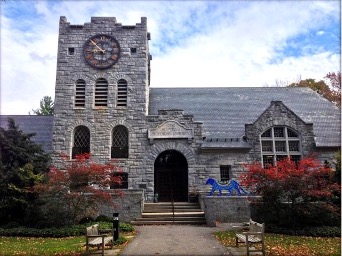
Scoville Memorial Library, first publicly funded library in the nation, Salisbury, CT / Courtesy cthistory.org
November is the “FAMILY LITERACY MONTH with Public libraries as the center of that concept. This is the history of how it all began.
Settlement of the Northwest Hills before this country was founded, and the voting in the midterm elections this year are separated by over 300 years. There is one cornerstone of democracy that spans the centuries between them; the public library. The first of these was established in the Northwest Corner of Connecticut 255 years ago.
Salisbury, Connecticut, led the Northwest Hills by planting an early seed for public libraries. In 1771, local business owner Richard Smith promised to buy 200 books from London, England, if the public would join him, according to connecticuthistory.org.
Thus, the Smith Library was created with support from 39 residents, writes Eric Chin for Connecticut History. Patrons could borrow and return books four times per year for a modest fee.
These founders supported the book exchange “for the promoting of virtue, education, and learning,” according to Chin. Smith fled the country during the Revolutionary War, but Salisbury native Caleb Bingham donated 150 books in 1803 to create a library for young people. This was followed by an 1810 town meeting and vote to expand the collection using $100 in Town funds.
Scoville Memorial Library in Salisbury was the first publicly funded library in the country. The collection was maintained in the Town Hall in the early years; a visible connection between democracy and literacy.
In the meantime, what’s sometimes called the nation’s first public library, though not publicly funded, originated around 1790 when Benjamin Franklin donated his book collection to the Massachusetts town that bore his name. Community leaders had asked Franklin for a bell for their church steeple.
“Books instead of a bell,” the renowned American statesman, writer and publisher wrote later, “Sense being preferable to sound.”
These early Americans shared with many others an interest in expanding educational opportunities, and public libraries became a vehicle to spread knowledge. For decades, access to books was a major challenge to this movement.
The difficulties did not deter book and education supporters.
One example is Maryland librarian Mary L. Titcomb, who, at 5 feet tall, was small in stature but big on the idea of books for everyone. Her philosophy and creativity led to the design of the “book wagon,” forerunner of the bookmobile, in 1904.
“The book goes to the man, not waiting for the man to come to the book,” Titcomb wrote in “The Story of the Washington County Library.”
The first tax-supported library was established in New Hampshire in 1833, and the first large public library in Boston in 1854. The Constitution State, not to be outdone, established the Connecticut State Library that same year by action of the General Assembly.
After the Civil War, creation of women’s associations accelerated nationwide. A new era of affordable domestic labor and available factory-made household goods gave women added leisure time, author Paula D. Watson wrote in The Library Quarterly.
Formally educated women joined those focused on expanding their schooling in study clubs and reading circles. By the 1870s, their collective efforts for self-improvement evolved into a civic crusade.
“Libraries were among the very earliest objects of club interest in community development,” Watson wrote.
Free local libraries began to pop up, housed in complimentary spaces and filled with donated books. Women’s associations held fundraising events to support the creation of public libraries and soon began to lobby the government for tax support.
By 1900, despite swift urban growth in the late 1800s, most Americans still lived in rural regions; nearly 46 million people or 60% of the total 76 million population. A focus on initiatives to provide books to people in isolated areas emerged.
Small traveling libraries were one answer. Larger women’s clubs shipped boxes of books to underserved areas, where the local ladies’ organizations distributed them. Trunks full of books were delivered to many towns.
Back East in Maryland, Titcomb (1852-1932) tried similar methods but worried her library was not reaching enough people. The horse- or mule-drawn bookmobile was born, featuring side cabinets, drawers and compartments.
By 1912, the first motorized bookmobiles hit the road, a fleet later expanded by 200 new vehicles thanks to the Library Services Act of 1956. That alone improved book circulation by more than 40% in many county and regional libraries.
Through it all, the common thread from 1771 in the Northwest Hills and 2026 at the ballot box nationwide is the role of public libraries in education.
“Libraries are nonpartisan, but they are not indifferent,” the American Library Association (ALA) states on its website. “As institutions that provide access to information, resources, programs, and public spaces for all members of a community, libraries are a cornerstone for civic engagement and more important than ever.”
November is Family Literacy Month, and the Public Library Association (PLA) looked at the key role libraries play in “Public Libraries: A Vital Space for Family Engagement,” a 2016 study by the Harvard Family Research Project.
“Education helps foster political engagement,” the study found, noting that affects political knowledge, interest, opinions, or attitudes. Learning makes a difference in actions citizens take to influence decisions of public officials, such as voting, protesting, and political membership, the project noted.
“Libraries are in a prime position to create and reinforce a pathway of family engagement that promotes children’s learning across time and across community and virtual spaces,” wrote Heather B. Weiss, director of the research project.
Public libraries remain held in high esteem by most Americans, as well. In a 2016 survey on Libraries and Learning, the Pew Research Center found 76% of adults say libraries serve the learning and educational needs of their communities either “very well” or “pretty well.”
Public libraries continue to be recognized as institutions for education, thus fostering more vigorous civic involvement, according to a 2021 academic paper in the International Journal of Educational Development.
“The robust and positive relationship between education and political engagement has been widely documented,” state authors Kien Le and My Nguyen, faculty of Economics and Public Management at Ho Chi Minh City Open University in Vietnam. “Education cultivates political interest, promotes the acquisition of political knowledge, and fosters supportive attitudes towards political freedoms.”
What education really impacts in civic engagement is quality, they said.
“The role of education in a representative democracy may not lie with increasing the quantity of citizens’ political involvement (voting and affiliation) but lie with enhancing the quality of their involvement (interest, knowledge, attitudes),” Le and Nguyen wrote. “A fully informed electorate can improve the quality of democracy.”
Family Literacy Month in November is a way to recognize the value of public libraries in an individual’s education at any age — value that has been appreciated since the Revolutionary War era. Libraries are bastions of education and, as a result, springboards to vigorous civic engagement.
Their role in nurturing an informed electorate and a bolstered democracy cannot be overstated.