SPOTLIGHT: Connecticut and George Washington Have Shared History
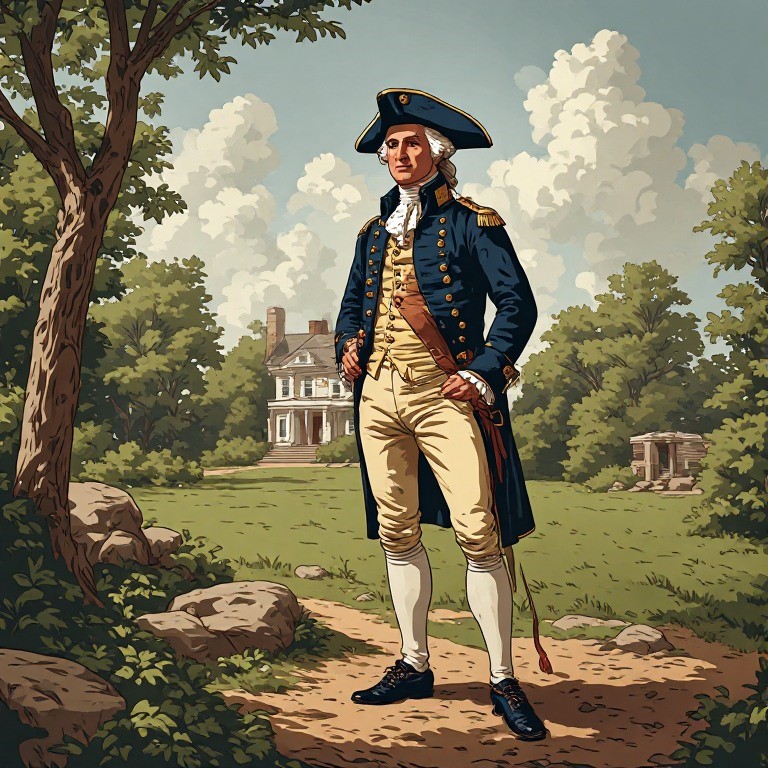
As America celebrates its 250th birthday on July 4, it’s worth remembering the people that made this celebration possible.
One of those was George Washington, who became this nation’s first president, a person that was well-acquainted with the state of Connecticut.
According to a May 17, 2002 article by Diana McCain on connecticuthistory.org, the first time Washington traveled through Connecticut, in 1756, he was an ambitious young Virginia colonel headed for Boston on a mission he hoped would advance his career in the British military.
When he last visited Connecticut, in 1789, he was the first President of the new United States, a nation that existed in large part thanks to Washington’s leadership of American troops to victory in the war for independence.
McCain wrote that the trips Washington made to or through Connecticut during the intervening years were in his role as Commander-In-Chief of the Continental army.
In 1775 he passed through Connecticut on his trip from Philadelphia to assume leadership of patriot troops gathered outside Boston to resist British tyranny.
In 1780 he made a secret journey from his headquarters in New Jersey to Hartford to meet with the patriots’ new allies, the French.
McCain writes although “George Washington slept here” has become a cliché, it is known for a fact that he did spend the night in a number of Connecticut towns, including Norwich, New London, Fairfield, Hartford, Litchfield, New Haven, Ashford, and Westport.
One location in which it is indisputably documented that George Washington slept, and that still stands, is the home of Joseph Webb in Wethersfield, today part of the Webb-Deane-Stevens Museum.
Here Washington spent five nights in May of 1781, participating in a conference with the patriots’ French allies on a plan that would lead to the surrender five months later in Yorktown, Virginia, of a British army commanded by General Cornwallis—a victory that would ensure the success of the American Revolution.
According to the Connecticut Tourism Office website, a critical late turning point in the war was the French entry and nowhere was this more dramatically seen than in the 1781 march of French troops across Connecticut to meet up with General Washington’s troops for a final steady push south to Yorktown. The Washington-Rochambeau Revolutionary Route in Connecticut is the state’s first National Historic Trail that covers 120 miles throughout the state.
In an article written by Kathryn Boughton on www.berkshirestyle.com, when Washington was given command of the Continental Army in 1775, he had to write a delicate letter home, telling his wife Martha what he had done.
He promised Martha he would be home in a matter of months. He would not. It would be six years before he revisited Mount Vernon and then for only the briefest of visits. In all, George spent eight years on the road, nearly 3,000 days and nights.
In all, Washington’s travels took him as far north as Maine and as far south as South Carolina. He visited Connecticut frequently and was not unknown in Litchfield County. Here, four sites can claim a Washington association and one town, Washington, was named in his honor.
So, what brought Washington to Litchfield County?
Boughton wrote the County had yet to gain its reputation as the place to go for the weekend, but it did have other allures for the commander-in-chief, not the least was its role as the Provision State, providing food and munitions for the army.
Important in this role was the town of Litchfield, a hotbed of sedition located at a crossroads between important Connecticut towns and the strategic military posts in the Hudson River Valley.
Boughton wrote that patriots used the town as a critical supply depot for military stores and munitions. The town had produced Governor Oliver Wolcott, a signer of the Declaration of Independence, and was where Benjamin Franklin’s Tory son, New Jersey Governor William Franklin, was imprisoned. It would, after the war, be the home of Washington’s spymaster, Benjamin Tallmadge, who lived on North Street.
Litchfield’s most unusual role in the Revolutionary War was played by its women and children.
In 1776, the Sons of Liberty pulled down the equestrian statue of King George III on Bowling Green in New York City. The pieces were sent on to Litchfield, where many of the town’s women and children cast them into 42,000 bullets in the orchard behind Wolcott’s South Street home.
Boughton wrote Washington spent at least one night in the town, date unknown.
As was his custom, he avoided any appearance of political favoritism by staying in a public house, Sheldon’s Tavern, built in 1760 for Elisha Sheldon.
Boughton wrote that overall, at least 20 historical markers located in Connecticut lay claim to having George Washington “pause,” “sleep,” “visit” or “travel through.”
In addition to the previously mentioned trips in 1775 and 1780, in 1781 Washington moved through the region on his way to Newport, Rhode Island to confer with the French.
Late Friday, March 2, 1781, he was in Dover, stopping for the night at the Morehouse Tavern, but Saturday saw him up early and making his way toward Kent, where he would cross the Housatonic on the then-uncovered bridge kept by Jacob Bull.
Records are not clear as to what happened when Washington and his military family crossed the river. Some sources say Bull was reconstructing the bridge and not all the planks had been secured.
Boughton wrote Washington finally went home in 1783.
“In 1789 he was on the road again, moving to New York City where he reluctantly assumed mythological status as the man who was “first in war, first in peace and first in the hearts of his countrymen” as our first president,” she wrote.