With More and Heavier Rain, More Inland Flooding in CT
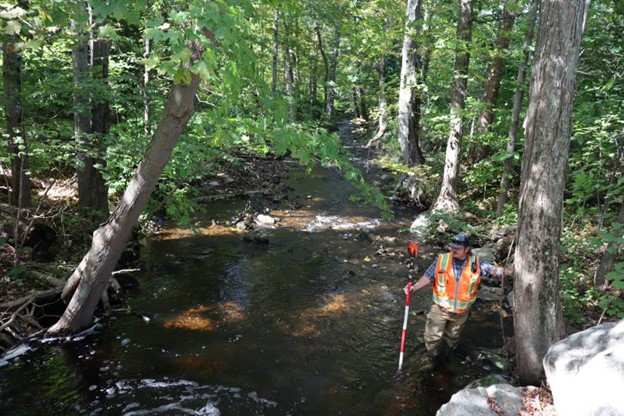
Mike Jastremski of the Housatonic Valley Association surveying a road-stream crossing over the Hockanum Brook. Jan Ellen Spiegel / CT Mirror
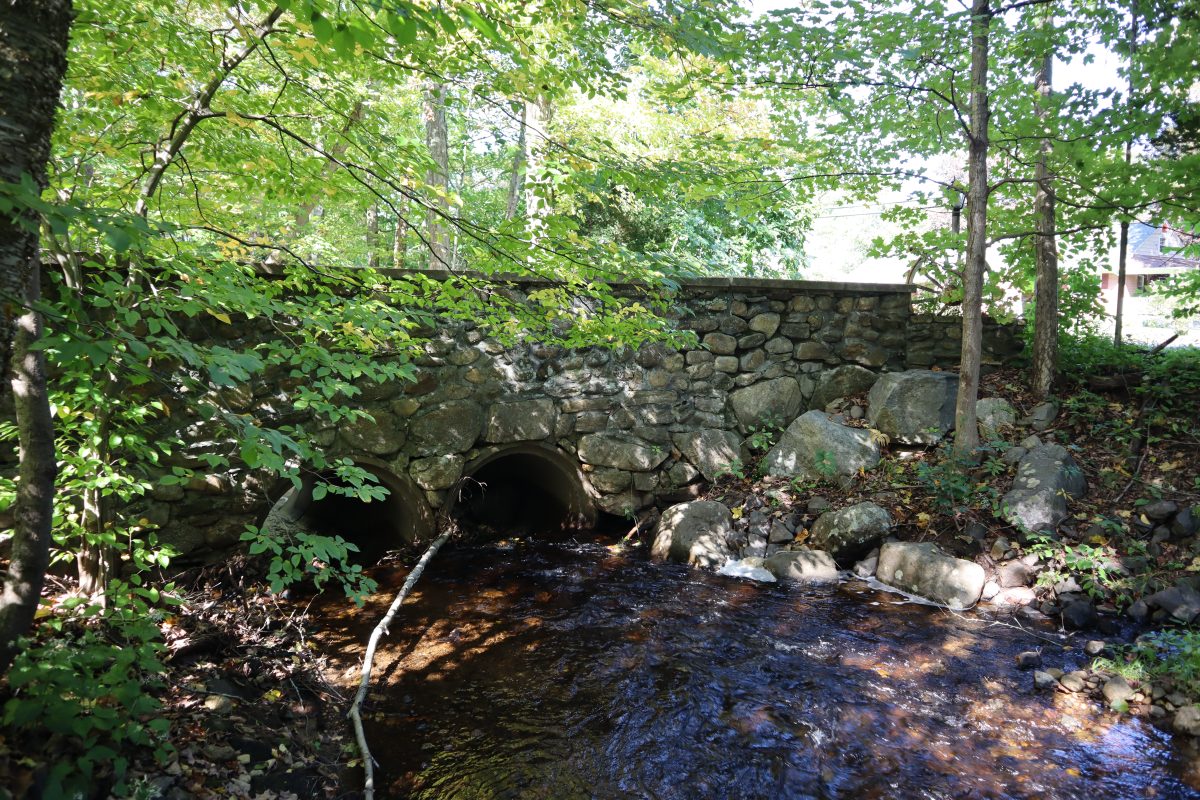 A driveway crosses over the Hockanum Brook in Beacon Falls. The culvert underneath the road is one of many in the Housatonic Valley that are too small and are deteriorating from excess water. The surrounding areas face flooding problems as a result. Jan Ellen Spiegel / CT Mirror
High water, high anxiety
Last summer made it clear that flooding is one of the greatest risks the Northeast faces from climate change. Warm air and oceans, along with sea level rise, mean more intense storms and floods — this summer, the summer of 2021 and likely summers in the future.
The Fifth National Climate Assessment, released in November, specifically noted extreme precipitation and flooding as a key climate change issue for the Northeast.
Hockanum Brook is practically singing as it bubbles along on a cloudless, deep-blue-sky on a late-September morning, just about a mile from where it empties into the Naugatuck River in central Beacon Falls. Seemingly idyllic and serene.
But it’s not.
That’s why Mike Jastremski and two other people were out there in waders and safety vests with surveying equipment, battling poison ivy and mosquitoes after three straight days of rain. The three are with the Housatonic Valley Association, a nonprofit founded in 1942 whose mission is to conserve that river’s watershed in the three states it traverses — Connecticut, New York and Massachusetts. But beginning in the early 2000s, when it became apparent that flooding was occurring more frequently, part of HVA’s focus shifted to dealing with that.
The torrential rains of summer and early fall of 2023 have driven the point home. “I think the pattern of high water has changed considerably,” said Jastremski, who is HVA’s watershed conservation director. “We’re getting more water per storm in a shorter period of time.” He noted that some of the traditional high water times — spring runoff from winter snows — have all but vanished.
HVA has been looking at what are called road-stream crossings — essentially bridges and culverts — throughout the watershed, which empties into Long Island Sound and includes other rivers such as the Naugatuck and all manner of tributaries and feeders, like Hockanum Brook.
“The problem arises when you have water that can’t get through the structure, can’t get through the pipe and ends up going over the road. That’s when you have culverts fail and that kind of thing,” he said.
They also hamper the movement of fish and other wildlife.
Even a non-expert can see trouble-in-the-making on Hockanum Brook where a culvert, consisting of two side-by-side old concrete pipes, goes under a driveway just beyond the spot where two water flows feed into it. Some supporting boulders are missing and other areas look to be loose. A long tree limb is stuck in one pipe and debris is piling up, threatening to block it altogether.
“What you’ll see at these structures that are undersized is the volume of the water, but also you can get things like debris blockages. In the wintertime, you can get ice jams,” Jastremski said.
This area has flooded the road — though not recently, partly because Robert Pruzinsky, the road foreman in Beacon Falls, is diligent about clearing storm drains and other water drainage areas, which is what he was doing a couple of days later in torrential rain.
“We’re constantly maintaining these crossings, like cleaning debris out of them and make sure everything’s flowing,” he said. “Especially with all the storms we’ve been having lately. They’re more than 100-year storms. They’re like 200-year storms.”
Such problems exist throughout the Housatonic region. That’s where HVA and other independent nonprofits come in. They have become essential tools for towns that generally lack the expertise to figure out and solve what’s going on, and — more to the point — lack the money to do anything about it.
Since around 2015, HVA has been going into communities in the watershed, surveying bridges and culverts both public and private. Using modeling developed at the University of Connecticut environmental engineering department, they can determine which ones are problematic and in need of some form of remediation. Then, working with the community, they figure out what the priorities are and do some design concepts for them. “All that gets packaged together with some background information as a road-stream crossing management plan for that particular community,” Jastrmeski said. “Then we work with each community to find the funding to actually implement the plans.”
That money part is music to the ears of people like Pruzinsky. “Absolutely,” he said. “We’re always pursuing grants for a lot of these road projects and any improvements we could do within our drainage system or our road system.”
It’s also music to people like Aaron Budris, who is the environmental planning director for the Naugatuck Valley Council of Governments, NVCOG. Most of the 19 municipalities in the COG are in the Housatonic watershed. Beacon Falls is one of them. “It’s all about the money,” he said. “It all comes down to municipalities. We think we can help them get funding, but then that only goes so far because a lot of these federal programs require 50% match, 25% match. It’s just always a fight to find that funding and to get these things done.”
In the mid-20th century, the federal government invested in a series of dams and channels to control flooding on the Naugatuck itself. But the river’s tributaries are not protected from flooding or flash flooding, Budris said. “That’s what we’re seeing now with the increased number of heavy rainfalls and increased rainfall in those events,” he said. “We’re getting these storms that we only saw once in a lifetime before. We’re seeing it every few years now, and it’s definitely having a having an impact on our towns.”
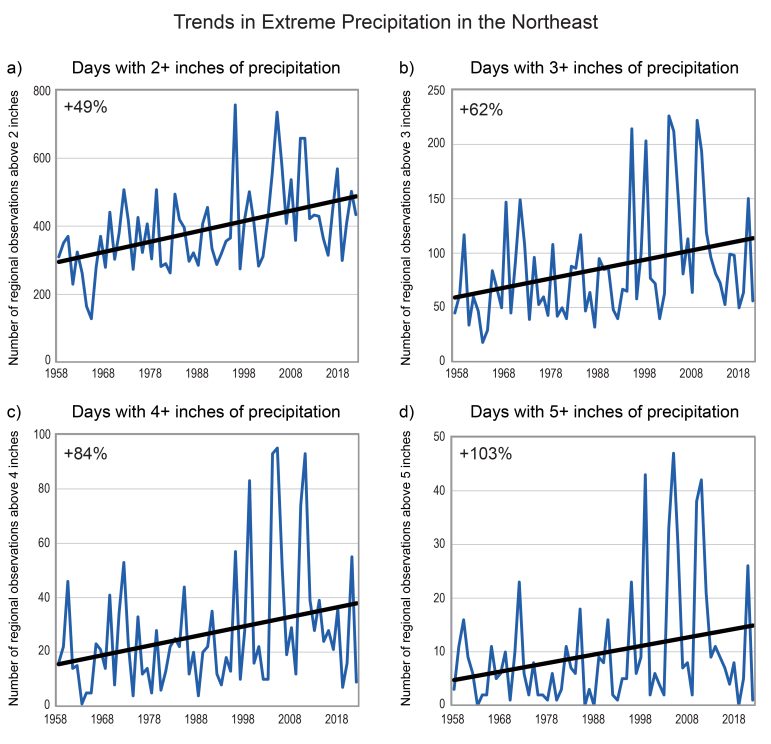
Data in the Fifth National Climate Assessment shows a clear increase in extreme precipitation events. USDA Forest Service, Drexel University, NOAA NCEI, and CISESS NC via Fifth National Climate Assessment
The Department of Energy and Environmental Protection now has a Climate Resilience Fund to help increase resilience at the regional, municipal and even neighborhood level. The first funding for that, $8.8 million, was awarded in June to 21 recipients in 17 communities, including just under $700,000 to NVCOG. Most of the grants were to address flooding problems.
Budris said he looked through the hazard mitigation plan the COG had done covering all 19 towns. Such plans are required to secure certain federal funds. “We pulled out projects that we felt would have a big impact if they did get funded.”
The money for the COG will go to nine communities for preliminary engineering, designs and cost estimates for culvert replacement and drainage system improvement projects as well as grant-writing assistance. In truth, it’s a drop in the bucket, pun intended.
“I gotta admit,” Budris said. “I think we’re sort of behind the behind the ball on this.”
High Water, High Anxiety
But fixing any of it is a slow process. No HVA project has been completed in Connecticut yet, though after a couple of years of design and permit work plus securing funding, the replacement of two structures in Kent that are flood risks could begin next year. It would reconnect three miles of cold water habitat in the Pond Mountain Brook watershed, allowing native eastern brook trout to move more easily.
The one complete project HVA can point to is in Pittsfield, Mass. Two culverts were replaced in 2018 and 2022, allowing wildlife to move more freely, as a trail-cam video taken by HVA’s partners at Berkshire Environmental Action showed. It has also significantly reduced maintenance costs for the city, which previously had to regularly remove sediment and debris blockages.
Back in Hockanum Brook, Jastremski points upstream. “Right now, these undersized structures upstream are serving to hold some of the water back,” he said. “If we were to upsize these structures up and not do anything here,” he said referring to the two old drainage pipes under the collapsing driveway, “this thing is gone.”
“We can’t really work on any one of them in isolation. … You really have to be looking at things holistically, to have the best chance of success. And that is certainly the case here.”