More CT Towns are Finding PFAS in Their Water Supplies
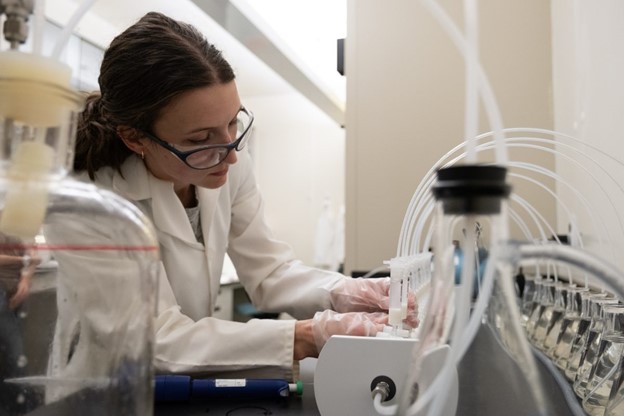
A researcher at the University of Connecticut samples water to test for per- and polyfluoroalkyl substances (PFAS). Shahrzad Rasekh / CT Mirror
Several public water suppliers serving parts of Colchester, Cromwell and Enfield recently detected so-called “forever chemicals” in their systems, making them the latest Connecticut utilities facing multimillion-dollar treatment upgrades or the prospect of finding entirely new sources of water.
New data released last week highlights the growing scope of the problem caused by the family of chemicals known as perfluoroalkyl and polyfluoroalkyl substances — PFAS for short.
Meanwhile, lawyers continue to battle in federal court over several proposed settlements that are meant to resolve the massive legal liability for that historic contamination that has fouled drinking water across the United States. Detectable levels of PFAS chemicals were found in portions of seven different water utilities, which supply thousands of Connecticut customers in various corners of the state.
Some of those utilities, including several owned by Aquarion Water Company and the Connecticut Water Company, were already aware the tap water that was being piped into people’s homes contained traces of the compounds because of voluntary sampling conducted in previous years.
But for other systems, like the ones operated by the Colchester Sewer and Water Commission, the Cromwell Fire District Water Department and the Hazardville Water Company in Enfield, the recent test results were the first indication that the chemicals had infiltrated their treatment plants. All three of those public water systems detected PFAS at levels that may soon require them to either find a new source of water or spend millions of dollars to treat for the chemicals.
The U.S. Environmental Protection Agency is in the process of finalizing a new rule that would, for the first time, set an enforceable limit on several of the most common types of PFAS that have been found in drinking water. That new rule is meant to limit people’s lifetime exposure to the chemicals, which researchers have studied for potential links to developmental issues, immunological problems, thyroid disorders and kidney or testicular cancers.
The pending regulation, however, is likely to come at a steep cost for water utility operators, which will be required to invest in new treatment technology that is capable of pulling PFAS out of their water supplies.