SPOTLIGHT: Harriet Beecher Stowe
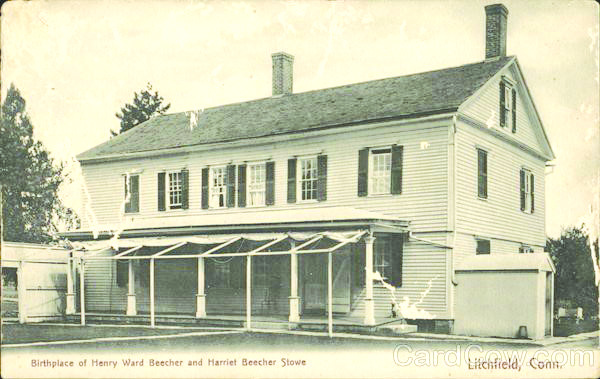
Abolitionist author Harriet Beecher Stowe was born on June 14, 1811, in Litchfield, Connecticut, and rose to fame in 1851 with the publication of her best-selling book, “Uncle Tom’s Cabin.” It highlighted the evils of slavery, angered the slaveholding South, and inspired pro-slavery copycat works in defense of the institution of slavery.
According to a 2017 article by Debra Michals posted on www.womenshistory.org, Stowe was the seventh child of minister Lyman Beecher and Roxana Foote Beecher.
Stowe’s mother died when she was 5 years old and, while her father remarried, her sister Catherine became the most pronounced influence on young Harriet’s life. At age 8, she began her education at the Litchfield Female Academy.
Later, in 1824, she attended Catherine Beecher’s Hartford Female Seminary, which exposed young women to many of the same courses available in men’s academies. Stowe became a teacher, working from 1829 to 1832 at the seminary. The final year at the seminary, Stowe’s father, Lyman, accepted the position of president at Lane Theological Seminary in Cincinnati, Ohio. Harriet accompanied him, Michals wrote.
There, she met some of the great minds and reformers of the day, including noted abolitionists.
Smitten with the landscape of the West, she published her first book, “Primary Geography,” in 1833, which celebrated the diverse cultures and vistas she encountered.
Harriet met and married Calvin Stowe, a professor at the Lane Seminary in 1836. He encouraged her writing, and Stowe wrote countless articles. She also wrote 30 books, covering a wide range of topics from homemaking to religion in nonfiction, as well as several novels.
Stowe was appalled when a pro-slavery mob sacked the premises of an abolitionist newspaper and vandalized the homes of free Black people in Cincinnati, author Geraldine Brooks wrote in her summer 2026 article for Smithsonian Magazine. A year later, in 1837, Elijah P. Lovejoy, another antislavery editor and a friend of the Beechers, was murdered by a riotous mob in Alton, Illinois.
The turning point in Stowe’s personal and literary life came in 1849, according to Michals, when her son died in a cholera epidemic that claimed nearly 3,000 lives in her region. She later said the loss of her child inspired in her a great empathy for enslaved mothers who had their children sold away from them.
The passage of the Fugitive Slave Act of 1850, which legally compelled Northerners to return runaway slaves, infuriated Stowe and many in the North. This intensified Stowe’s antislavery passions, Brooks wrote. She witnessed slave catchers, enabled by the Fugitive Slave Act, actively hunting escapees who’d made it across the Ohio River.
This was when Stowe penned “Uncle Tom’s Cabin,” according to Michals. Originally it was serialized in the National Era, and Stowe saw her tale as a call to arms for Northerners to defy the Fugitive Slave Act.
“Uncle Tom’s Cabin” was released as a book in March 1852, selling 300,000 copies in the first year. It was later performed on stage and translated into dozens of languages.
When some claimed her portrait of slavery was inaccurate, Stowe published “Key to Uncle Tom’s Cabin,” a book of primary source historical documents that backed up her account, including the narratives of notable former slaves Frederick Douglass and Josiah Henderson. Southern pro-slavery advocates countered with books of their own.
Stowe used her fame to petition to end slavery, according to Michals. She toured nationally and internationally, speaking about her book and donating some of what she earned to help the antislavery cause. She also wrote extensively on behalf of abolition.
During the Civil War, Stowe became one of the most visible professional writers. For years, popular folklore claimed that President Abraham Lincoln, upon meeting Stowe in 1862, said, “So you’re the woman who wrote the book that started this great war.” That quote, published in a 1911 biography of Stowe by her son Charles, has been called into question, as Stowe herself and two others present at the meeting make no reference to it in their accounts (and Charles was only a boy at the time of the meeting).
In 1873, Stowe and her family moved to Hartford, Connecticut, where she remained until her death in 1896, summering in Florida. She helped breathe new life into the Wadsworth Atheneum Museum of Art, and was involved with efforts to launch the Hartford Art School, later part of the University of Hartford.
“Uncle Tom’s Cabin” was the best-selling book released in the 19th century, second only to the Bible, and the first American novel translated into Chinese, according to Brooks.
In her novel’s “concluding remarks,” Stowe discloses that for many years she considered the subject of enslavement “too painful to be inquired into.”
Although thousands of Americans read the book, many more thousands saw theatrical adaptations of the story performed on stages across America long after the Civil War, Brooks wrote. In Lexington, Kentucky, in the early 1900s, the United Daughters of the Confederacy lobbied an opera house unsuccessfully to have the wildly popular play shut down.
The group then turned to the state legislature, which in 1906 passed Uncle Tom’s Cabin Law, allowing censorship of any production depicting past race relations in a bad light. The Daughters had argued that such depictions were injurious, especially to the “plastic minds” of children, and “unjust to the memories of their fathers.”
Brooks wrote that Stowe would not have agreed.
In her novel’s concluding remarks, Stowe wrote: “Nothing of tragedy can be written, can be spoken, can be conceived, that equals the frightful reality of scenes daily and hourly acting on our shores, beneath the shadow of American law, and the shadow of the cross of Christ.
“And now, men and women of America, is this a thing to be trifled with, apologized for, and passed over in silence?”