History: Floods of 1955 A Look Back
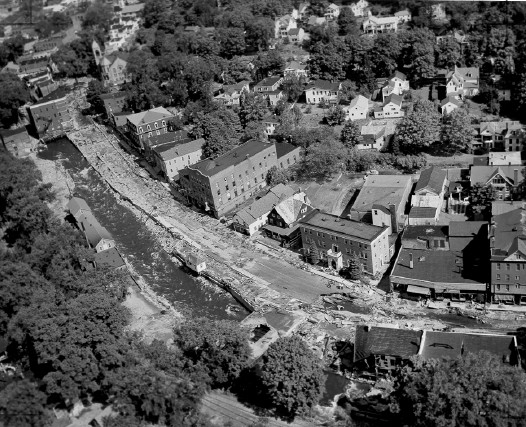
Winsted, Aerial view of Mad River and Destruction, August 20, 1955, Photograph by Military Department, State of Connecticut
August will mark 70 years since one of the most devastating – and highly unusual – flood events in the region’s history. In August of 1955, a pair of hurricanes passed through the Naugatuck Valley in quick succession. First was Hurricane Connie, which crossed through the East Coast on August 11-13. Connie was not a direct hit in Connecticut, ultimately resulting in 4-to-6 inches of rain, but did bring water levels above normal. One week later came Hurricane Diane, which wreaked far more havoc.
Rainfall totals across Connecticut ranged from 13-to-20 inches from Diane alone. That, compounded with the rainfall from Connie, resulted in widespread river flooding and dam failures. The Housatonic and Farmington Rivers, among others, reached record or near-record water levels – with the Housatonic climbing to 24.50 feet.
The National Guard was mobilized, and helicopters were used for rescues. In total, 180 people died across the country in the story, 77 of which were in Connecticut. Torrington Emergency Management put the number of Connecticut deaths at 87 including people who suffered heart attacks while being rescued.
The property damage was vast. There was over $350 million in damage Connecticut alone, accounting for more than half of the nationwide recovery price tag. The state report that was released three months after the flood said 668 dwellings were totally destroyed, with another 2,460 suffering major damage.
President Eisenhower flew over the damage in Connecticut, later saying "You can have no conception of what has happened until you come here."
Winsted was the hardest hit town in the Northwest Corner. The Mad and Still Rivers had massive floods that ultimately led to the destruction of a large swath of the downtown, killing eight people. Some of the downtown area that was wiped out did not get rebuilt. Today, the tragedy is remembered with a monument that includes the names of the victims in East End Park.
Beyond Winsted, Norfolk saw 21.81 inches of rain, while Warren had 18.60 inches and Falls Village recorded 16.83 inches.
In the aftermath, roughly $70 million was committed to building flood walls and dams along Connecticut Rivers – among them the Thomaston Dam in 1960 that is one of the largest flood control measures ever built by the Army Corps of Engineers. Hall Meadow Brook Dam in 1962 and the Northfield Brook Dam in 1965 also were established.
Resilience was everywhere as communities rebuilt. Torrington developed a new housing authority and planning commission to help the suddenly homeless and get the city’s businesses back on their feet. When the Center Bridge on the edge of town washed away in the floods, it instead became an opportunity to build a wider, more modern bridge to provide better access into the city.
It took years for communities to rebuild, but ultimately the floods thrust some communities into big changes. Now, even as towns continue to modernize decades later, the impact of the work done following the devastation has played an important role in shaping the region to what it is today.