Mike’s Beehives, the New Buzz in Goshen
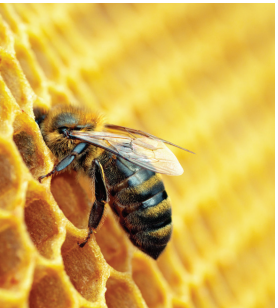
Goshen is often called the “Land of Milk and Honey”. Our landscapes are dotted with apiaries, increasing the productivity of our fields, gardens and orchards. The bees ask so little of us and offer so much. Roughly 1/3 of our food supply comes from fruits, vegetables and grains that are directly pollinated by bees. We also enjoy numerous nonedible products using honey, pollen, nectar, or beeswax in cosmetics, medicines, candles, cleaning products, and other applications.
Our story began years ago when Ed Bahr met Mike Rice, a vendor at the Hartford Flower and Garden Show. Mike was selling honey and showing gardeners the benefits of beekeeping, promoting his Roxbury business, “Mike’s Beehives”. Ed grew up in Roxbury where his father also kept bees. “All my friends had cats or dogs, we had bees. I learned my father’s ways. I was comfortable working with bees.”
After Ed graduated from Shepaug in 1981, he worked for several automotive repair garages, but by the mid-80’s he had married, found a home in Goshen, and established his own repair shop on South Main Street in Torrington.
Meanwhile, Mike’s business was thriving, but Mike wasn’t. He was fighting a 10 year, losing battle with cancer. Ed took over Mike’s Beehives, moving the business to his South Main Street garage. He eventually sold his automotive repair business to expand Mike’s Beehives, keeping the name in Mike’s memory.
Ed recently moved Mike’s Beehives to his home at 80 Holmes Road in Goshen, where he’s currently building a new storefront, warehouse, honey processing and training center. He has his own gardens, a small orchard and 50 of his own hives. Holmes Road is a dirt road, somewhat off the beaten path, but beekeepers from all over New England and beyond find their way to his door. Ed has sold over 900 Starter kits to establish new hives for gardeners and orchard owners this spring. He offers classes and diagnostic services to beekeepers whose hives are failing. He speaks at schools and agricultural programs and hopes to bring students to his facilities. He even offers onsite services to care for hives locally.
Bees originated in the tropical areas of Africa and Europe, adapting to cooler, more temperate areas as they expanded northward. Those that were able to produce and store honey were able live off that honey, surviving droughts, rainy seasons and cooler weather.
Honeybees were brought to North America by early settlers in Virginia in 1622, to Massachusetts in 1639, and to Connecticut in 1650. In 1848, the Mormons brought honeybees west to Utah, which has become known as the “Beehive State”. From there they migrated westward, over the Rockies.
A bee colony is both simple and complex; Simple because it revolves around a single queen, a small handful of male mating drones and 60-80,000 female worker bees. The queen develops in 16-17 days. Once she emerges, she immediately mates and begins laying eggs; 1,500 to 2,000 a day. The worker bees begin as nurses, feeding the eggs, storing food, waxing over the larva, and cleaning the hive of debris. As they work, they constantly fan the hive to maintain temperature and strengthen their wings. Later they become guards, protectors and ‘bouncers’ letting only their own workers into their hive. Finally, they become foragers, gathering pollen and nectar, until their 35–40-day life comes to an end.
It is also complex, because the entire colony must be viewed as a living organism, with its own wants and needs, communicated through the hive’s individual set of pheromones spread by touch, almost akin to our nerve synapses. It’s the beekeeper’s job is to know when and how to best work with his bees to ensure health, growth, development, and survival, to secure maximum honey production. Keeping bees healthy is a growing concern for today’s apiarian. Because foraging bees may travel several miles collecting nectar and pollen, it’s almost impossible to avoid the insecticides, pesticides, chemical fertilizers, and pollutants that are eradicating so many of our honeybees. Cleaner, more environmentally compatible methods are needed, both for our bees and for ourselves!