Understanding Nutrition Labels
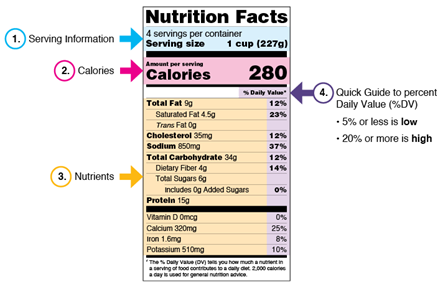
Understanding a few details on the nutrition label can help you make better decisions for your health.
- Serving Sizes and Calories –What looks like a normal serving size may be more than you think. The nutrition label will tell you the serving size and also how many servings are in a package. This means rather than trying to figure how many ounces of something you will eat, you can focus on the ratio.
As an example, if the label indicates there are 4 servings in the package but you plan to eat half the package, then all you need to know is how many calories are in the whole package and divide it in half. Compare this number to the total number of calories you plan to eat in a day. See Chart below for a general idea of your recommended caloric intake per day. Let’s just use a 2000 calorie daily allowance as an example:
If what you plan to eat is 500 calories, that would be 25% of your caloric intake for the day. Ask yourself if that ratio makes sense for what you’re eating. If those 500 calories are for a meal then 25% of your daily caloric intake could be fine. If you’re talking about a 500 calorie snack or beverage and you’ll still be eating your normal meals, then 500 calories could be too large of a portion of your daily calories to meet your health goals.

- Nutrients – Nutrition labels are helpful when determining how much of each key micronutrient you’re getting in a day. Focusing on all nutrients at once can be a little overwhelming but a great place to start is fiber.
Fiber is often underrepresented in our diets and undervalued for the impact it has on our health. Fiber supports a healthy digestive system, keeps us feeling full for longer and also helps our body to avoid blood sugar spikes. Try tracking your fiber against the recommended 28g per day to see where you stand. Once you’ve incorporated some healthy habits to boost your fiber intake, try focusing on a different nutrient and doing the same. We will be highlighting different nutrients in future articles to help you better plan a nutritional diet. Eat well!
To learn more about nutrition labels and to take a closer look at the sample label above, please visit:
www.fda.gov/NewNutritionFactsLabel
Kathleen Reynolds
ISSA Certified Personal Trainer
Group Fitness Instructor