Let's Talk Turkey
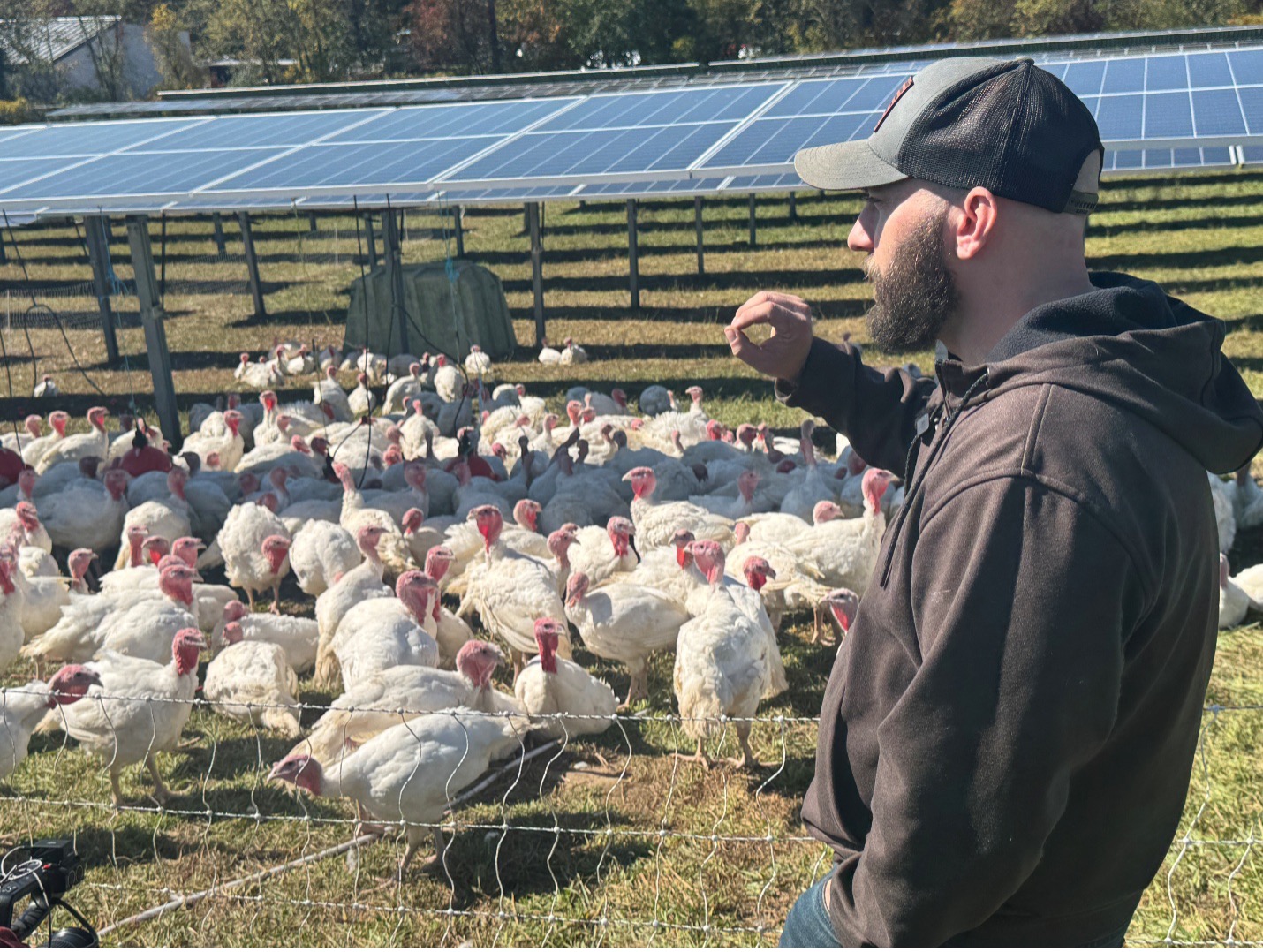
Turkeys at Steadfast Farms graze amidst a solar collector array/Photo Courtesy of Steadfast Farms
For many of us, celebrating Thanksgiving centers around faith, family, friends and a full dinner, featuring a farm fresh turkey, the all-American bird. Yes, we Americans consume more than 46 million turkeys each Thanksgiving, accentuated by cranberries, stuffing, gravies, and our favorite native vegetables. An entire industry has evolved around the raising, processing and marketing of this one bird alone, native only to the Americas.
Our American Indians eagerly hunted flocks of wild turkeys, considering them a symbol of ‘friendship and plenty’. Mayans are pictured as using turkey bones and feathers ceremonially. Aztecs are credited as first domesticating and breeding turkeys around 800 BC. They favored and developed white turkeys, selling over 1000 daily at their markets. These were the forefathers of the white, broad breasted turkey raised commercially today. Spanish explorers returned with these turkeys in 1498. Within 20 years, turkeys were bred and used for meat production throughout Europe. Several subspecies were developed, more successful in varying localities. In 1607, Jamestown settlers brought these domestic breeds to Virginia, which, of course, thrived. Today, we find three turkey types; the wild turkeys you might find in your backyard, the heritage turkeys, pure bred for show and meat production, and the commercial broad-breasted white turkey, bred for size and succulence. The commercial broad-breasted turkeys are often fatty, can hardly walk and must be bred artificially.
Our organic growers favor heritage varieties, often competing in county fairs and poultry shows. We have several growers in our Northwest Corner. Most purchase poults, just a couple days old, from certified breeders, late in March or early April. Poults are extremely vulnerable during their first 4 weeks of life. They must, initially, be kept in a well-lit brooder at 95 degrees F. They must be ‘taught’ to eat, dipping their beaks into starter mash. They will peck at anything shiny, more out of curiosity than hunger. Poults are highly susceptible to a variety of diseases, ticks and lice. Growers keep them indoors, in raised cages, so that their droppings might fall through the mesh while the poults stay clean and dry. They subsist on a high protein (24-28%) diet. After 4 weeks, the poults begin to grow feathers and tolerate cooler temperatures. They can gradually be introduced to sunshine, and moderate outdoor temperatures. The protein in their diet, can then be reduced to 22%. Once outdoors, a turkey can subsist on pasture, supplemented with a pound of feed a day, until reaching maturity in 3-4 months. Extra grain is added during the last month, usually October, to prepare the birds for market.
Hoadley Hills Farm in South Kent, owned and operated by Tyler Hoadley, is a major grower here, in the Northwest Corner. This family farm is run with the help of his wife, dad, brother and sister. Initially, his dad raised layer chickens as a hobby, providing fresh eggs for his household and neighbors. Tyler finished college with a degree in chemistry, returning home with concerns about the chemicals used in growing and processing meats. He expanded the farm. Currently, he raises 800 organically grown chickens and turkeys, using the ‘Minnesota Plan’, that is, keeping his birds in open bottomed coops, shifting them daily on his well- drained, hillside pastures. He is also using a passel of pigs to clear some of his grandmother’s land, opening new pastures, and raising organically grown pigs for market. He has 360 fully certified organic turkeys ready for this Thanksgivings’ market. Processing so many has become too burdensome, so he now ships them out for organic processing.
The Steadfast poultry farm and processing center is located on 1-1/3 acres in Bethlehem. Jared McCool owner and operator had served in the Marines during operation ‘Enduring Freedom’ (2008- 2014). He earned his BA in Criminal Justice at the University of New Haven, planning to work in law enforcement. Changes in police policies and processes redirected his future.
Jared was invited to join several friends on a pheasant hunt that proved to be fruitless. One friend convinced him to come along once again to ‘try out’ his 8-week-old German Shorthaired Pointer puppy, Boone. Amazingly, Boone was able to flush out a pheasant within minutes. Jared soon got his own German Shorthaired Pointer, Remi. He and his partner began raising game birds for sale and release. In 2016 they found property in Bethlehem. While they now had the space to raise gamebirds, they were unable to make their venture profitable. When the partnership split up, Jared focused on marketing, successfully selling mature gamebirds to specialty restaurants. His neighbor offered him an adjacent land lease under fenced in, solar collectors. This gave the farm the additional space needed to raise turkeys; 300 of them. He has since put together a hardworking team, bringing his birds from poult through processing.
The Steadfast processing center is approved by the Torrington Area Health District, the USDA and the FDA. It’s the only organic poultry processer in Connecticut. As well as processing and packaging their own poultry, Steadfast also handles poultry from smaller farms, even offering specialized labeling. Jared continues to seek marketing opportunities, working with fellow farmers and grocers or vending at fairs and farm markets. Jared is hoping to shift Steadfast from seasonal to year ‘round sales, accommodating both the consumer and his own workforce, packaging special cuts, sausage and convenience foods.
Both organic growers work conscientiously to minimize their ‘environmental footprint’, cleaning, reusing, recycling and composting, to constantly improve their land, minimize costs and enrich their farms for happy, healthy, tastier turkeys and poultry products.
Happy Thanksgiving from all of us here!