SPOTLIGHT: The Boom and Bust of the Silk Industry in Connecticut
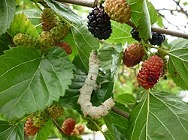
Silkworm feeding on a mulberry leaf/Wikimedia.com
In the 1830’s, Connecticut farmer Elder Sharp rejected an offer of $450 to purchase a quarter share of his $50 mulberry tree. Within months, the tree was worthless.
Sharp, of North Windham, was just one of many Nutmeggers caught up in the silkworm craze that at one time promised fortune and prosperity. Tens of thousands of cultivated mulberry trees were planted across the state’s landscape, according to author Bob Wyss, at connecticuthistory.org. The industry, however, ended suddenly, leaving a legacy of invasive species known to “escape from cultivation.”
Success was seen in silk in the early days of the nation. The Connecticut Colonial Assembly approved legislation in 1734 to offer financial incentives for silk growers, Wyss wrote. U.S. President George Washington would remark in a 1789 trip to Connecticut on the quality of the silk thread that was part of a growing industry at the time, wrote Taryn Skinner for Atlas Obscura.
The silkworm had been employed in China for thousands of years to spin up a luxurious fabric that became a hot commodity around the globe. Silkworms produce a cocoon that can be unraveled and spun into silk thread.
“Sericulture” or silk production from Windham County to Mansfield and Manchester made this state “the epicenter of US raw-silk production,” Wyss wrote. Horticulturalist Nathaniel Aspinwall in the 1750s and Yale College President Ezra Stiles from 1763 to 1790 were among those who helped the state earn this title, Wyss wrote.
Long before, the Chinese had discovered the silkworm’s affinity for mulberry leaves — and the more they ate, the more cocoons they produced for the manufacture of silk. Aspinwall planted mulberry trees in Mansfield and New Haven to feed the silk industry. Stiles worked through churches statewide to ship mulberry tree seeds to pastors, who then were instructed to distribute trees for free to local families and continue cultivating them, Wyss wrote.
Nationally, Connecticut became a leader in silk production by the early 1800s, according to Wyss. In Mansfield in 1825, for example, ¾ of all households participated in the process. By 1840, the Constitution State churned out three times as much silk as any other state. Mulberry trees were aplenty, but the silkworms consumed a massive quantity of leaves.
Imported silk was known for its better quality and preferred by mills in the U.S., Wyss wrote, but suddenly a silkworm craze spread across America from about 1830 to 1844. About this time, a new species of mulberry tree arrived on East Coast shores.
Red mulberry trees are native to North America, but silkworms had a taste for imported white mulberry trees. As the “mulberry craze” took hold, the new breed of fast-growing mulberry trees from China, known as the M. multicaulis at that time, began to be planted by the tens of thousands.
Trees grew. Profits soared. As Wyss wrote, “The New England Farmer reported, ‘We hear daily reports of individuals who have made their thousands and tens of thousands of dollars and the storekeeper, farmer, mechanic, etc. rush from their useful employment into the grand speculation.’”
Perhaps Elder Sharp, then, could hardly be blamed for jumping at the chance when he bought his mulberry tree for $50, especially since the Connecticut farmer didn’t know the speculator who sold it to him had acquired the plant for $25 in Massachusetts.
Then came the financial crash dubbed the Panic of 1837, attributed to a real estate bubble, according to Harvard Business School. That was followed by the rapid decline in the price of mulberry trees throughout 1839, Wyss wrote. Trees that brought up to $1.25 apiece as that year began dropped to prices of 2 to 4 cents within 12 months, according to Wyss.
Connecticut, and particularly Mansfield, suffered financial ruin that year. Then the harsh winter of 1840 that followed killed many of the mulberry trees, Wyss wrote. Mulberry orchards were then all but wiped out by blight in 1844, according to the History of Forestry in Connecticut by Austin F. Hawes.
Decades later, Old Time silk culturists met in Mansfield on June 1, 1881, and reminisced about the “silk culture in their younger days,” according to an account in The Willimantic Chronicle shared via the Windham County Connecticut CTGenweb Project. Chair William Atwater recalled the “most profitable and interesting branch of farming interests” during which his own family and farm produced 130 pounds of raw silk on average for years, The Chronicle reported.
Elder Sharp is noted as present at the meeting. “’Twas unfortunate we had lost sight of the grand object. Our silk was good, bright and strong,” he stated, according to the account.
Attendee Capt. Joseph Conant had the last word on the topic, reported by T. Storrs, Clerk, according to The Chronicle. He told those present that they all, himself included, had “killed the goose that laid them golden eggs hoping to find a bonanza.”
“Instead of cultivating our hardy trees and improving ourselves with patience in the reeling our excellent cocoons, we made haste to be rich,” Conant said.
Today, the white mulberry or common mulberry is the Morus alba and warrants a special note from the University of Connecticut’s College of Agriculture, Health and Natural Resources.
“This species has demonstrated an invasive tendency in Connecticut, meaning it may escape from cultivation and naturalize in minimally managed areas,” UConn’s Plant Database states.