Turning Crops into a Tool for PFA’s Remediation
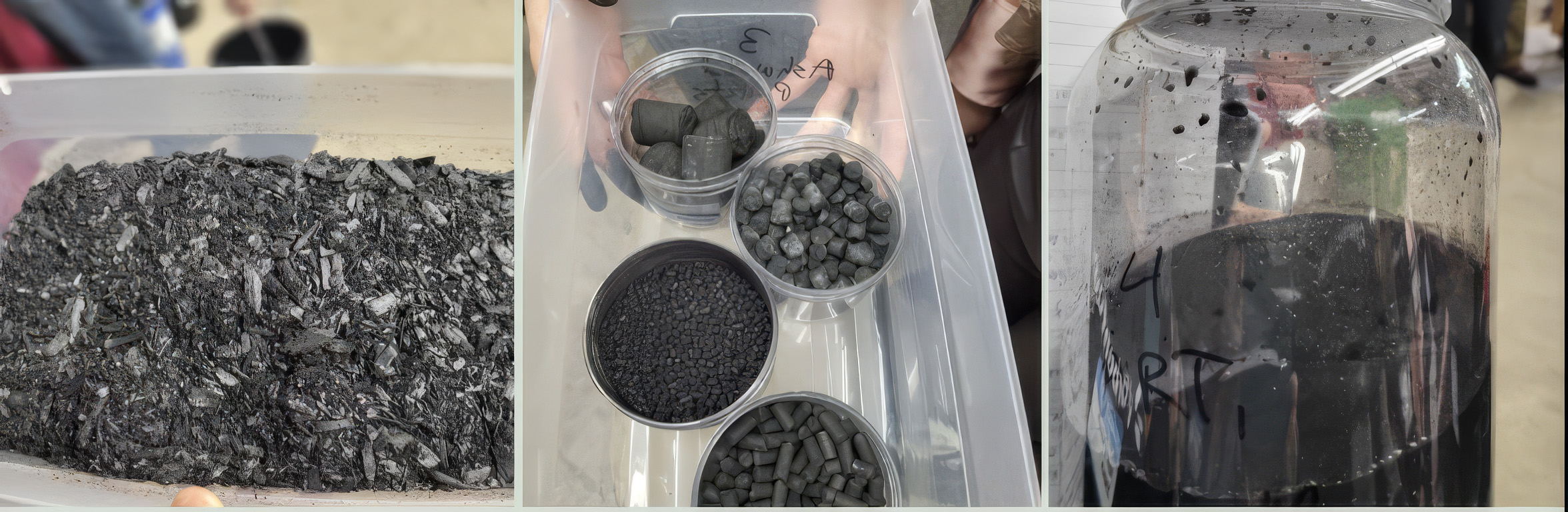
Biochar can be made from any type of carbon source and comes in many different shapes and sizes from small chunks of wood-based biochar (left), to compressed prills (center) which can be no-till drilled into soils, to fine particles (right) which can be suspended in water and distributed through irrigation or injection methods. Credit: USDA NRCS
Chemical Engineering Progress magazine’s (CEP) September edition reports on a novel process for getting rid of PFA’s, the pervasive “forever chemicals” contaminating soil and groundwater. The method, originally detailed in the Proceedings of the National Academy of Sciences, involves planting crops that can absorb the carbon-fluorine PFA compounds and then pyrolyzing the resulting biomass to form biochar.
Pyrolysis is the heating of an organic material in the absence of oxygen. Biomass pyrolysis is usually conducted at or above 500 °C (932 °F), providing enough heat to destroy PFA’s, producing a clean biochar. Because no oxygen is present combustion does not occur; the biomass thermally decomposes.
The method “could remediate millions of acres of contaminated farmland at far lower costs than heat treatment or landfilling”, according to the CEP article. Farmland contamination is a result of the practice of using treated sewage sludge as fertilizer.
Suitable crops could include hemp, willow, and perennial grasses.
The following excerpts from the USDA website detail the benefits of biochar.
Digging into Biochar
Biochar has been gaining popularity in the Northeast over the last few years as a soil amendment in crop fields and pastures, but farmers still have a lot of questions.
According to the US Biochar Initiative, biochar is a charcoal-like product made by pyrolysis, which is the process of heating biomass (wood, manure, crop residues, etc.) with limited to no oxygen. Biochar has been used in agriculture for more than 2,500 years and is becoming increasingly popular in modern agriculture as a safe, sustainable way to add carbon to the soil.
Organic matter serves an important function and can maintain or increase productivity of soil by increasing water holding capacity, reducing erosion, allowing greater nutrient uptake, reducing nutrient loss, and increasing microbial activity. Excess organic materials, such as waste wood or waste from food processing such as nut hulls or animal manures, can be turned into biochar. The result can help improve the productivity of degraded soils that have a low pH, erosion or compaction problems, low cation exchange capacity, and/or poor infiltration. For the most part, adding carbon to soils will improve them.
Biochar is a little different than other soil amendments. Traditional soil amendments such as fertilizer, lime, or manure, are mostly used for their chemical properties to improve crop productivity. The benefit of biochar is that when added to soil, it also improves biological and physical properties.
How is biochar produced?
Biochar was traditionally made through piling, covering, and burning vegetation slowly in a low oxygen environment. While this method is still used by communities around the world, there are newer, large-scale methods being used in the US. Biochar can be made in kilns that range in size from small stoves or mobile units to large, industrial size facilities.
How is biochar applied to the soil?
Biochar can be applied any way that soil amendments are applied such as through tillage, surface application, no-till drill or seed slot, trenching when planting perennial crops, injection, or suspended in water through irrigation.
What makes biochar climate-friendly?
Converting organic matter to biochar can mitigate greenhouse gas emissions from decomposing waste. Biochar is made up of stable carbon-based compounds that take thousands of years to decompose; thereby sequestering carbon into the soil.
Furthermore, biochar reduces the need for fertilizer because it holds onto nutrients, which both increases nutrient availability to plants and reduces nutrient loss caused by leaching. According to the US Environmental Protection Agency, nitrous oxide from fertilizer is the largest greenhouse gas carbon equivalent emission from agriculture. It is so large, that it is nearly double that of the second highest source of emissions, which is enteric fermentation from livestock.
How is biochar used in the Northeast?
Most farmers in the Northeast who use biochar are using a compost-biochar blend of 70-90% compost to 10-30% biochar. Typically, the best results will be seen when biochar is mixed with compost and allowed to sit for a couple of weeks to “charge” in order to prevent yield drag in the first year.
When purchasing biochar, look for a hydrogen to carbon (H:Corg) ratio of less than 0.7 which means it is very stable and will last in the soil for hundreds of years and more.
It should be noted that biochar can raise the pH of soils, especially if the biochar has a high ash content, so it may not be a good option for neutral or basic soils. Also, some biochar is high in salts. For example, those made from manure should be used with caution in soils with high electrical conductivity. Generally, wood chip-based biochar that has been mixed with compost or manure and applied at 4-10 cubic yards per acre can have a positive crop yield effect in most soils.
Funding for Biochar on Farms
Farmers have traditionally preserved or added organic matter back to fields by growing cover crops, rotating with perennial crops (such as alfalfa), minimizing disturbance (reduced or no till), leaving crop residue in fields, and/or spreading manure. These practices take a long time to increase soil organic matter; biochar can raise levels much more quickly.
In 2022, the USDA Natural Resources Conservation Service (NRCS) established Conservation Practice Standard (CPS) 336 Soil Carbon Amendment. It provides technical and financial assistance to eligible farmers who wish to maintain or increase carbon in their soils by adding amendments such as compost, biochar, or a mixture of both. Contact the local USDA office for more information.