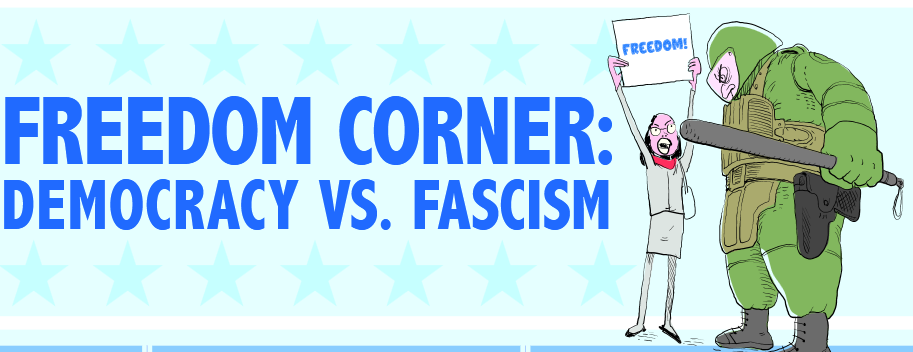
FREEDOM CORNER: Democracy vs. Fascism
|
Aspect |
Democracy |
Fascism |
|
Definition |
A system where power is held by the people through elected representatives. |
An authoritarian political system led by a dictatorial leader or party. |
|
Political Authority |
Authority is derived from the consent of the governed through elections. |
Authority is centralized and often derived from force or coercion. |
|
Example |
United States, where officials are elected through democratic processes. |
North Korea, governed by Kim Jong-un without competitive elections. |
|
Civil Liberties |
Strong emphasis on individual rights, including freedom of speech, assembly, and press. |
Civil liberties are severely restricted; dissent is often punished. |
|
Example |
In Canada, citizens can freely express their opinions and protest. |
In China, dissent is suppressed, and activists risk imprisonment. |
|
Media Freedom |
Media operates independently, with the ability to criticize the government. |
Media is state-controlled, often serving as a tool for propaganda. |
|
Example |
German media can investigate and report on government actions without censorship. |
In Russia, state media dominates, and independent journalism faces threats. |
|
Political Pluralism |
Multiple political parties are allowed, fostering a range of ideologies. |
Usually characterized by a single-party system; opposition is often banned. |
|
Example |
India, with a vibrant multi-party system including parties like the BJP and Congress. |
Italy under Mussolini, where the Fascist Party was the only legal party. |
|
Economic System |
Generally market-oriented with regulations to ensure fairness and support for social welfare. |
Often involves state control of the economy and prioritization of certain industries. |
|
Example |
Scandinavian countries combining market economies with strong welfare states. |
Nazi Germany, where the state controlled key industries and prioritized militarization. |
|
Nationalism |
Promotes inclusive nationalism that values diversity and unity among citizens. |
Emphasizes exclusionary nationalism that often leads to xenophobia and ethnic superiority. |
|
Example |
Canada’s approach to multiculturalism supports diverse cultural identities. |
Hungary's government promotes ethnic nationalism, often marginalizing minorities. |
|
Use of Violence |
Conflict resolution is typically achieved through dialogue, legal processes, and peaceful protests. |
Violence is often used as a tool to suppress dissent and maintain control. |
|
Example |
Peaceful transitions of power through elections, such as in South Africa post-apartheid. |
In Myanmar, the military junta employs violent crackdowns on civilian protests. |
|
Citizens' Role |
Citizens actively participate in governance through voting and civic engagement. |
Citizens are often seen as subjects of the state, with limited input in governance. |
|
Example |
In Switzerland, citizens can vote on referendums and have a direct say in laws. |
In fascist regimes, such as Italy under Mussolini, citizen participation is minimal and often manipulated. |
|
Education and Propaganda |
Education is geared towards critical thinking, fostering informed citizens. |
Education is often state-controlled, focusing on indoctrination and loyalty to the regime. |
|
Example |
Democratic countries encourage diverse curricula and critical discourse in schools. |
In North Korea, the education system is tightly controlled to promote loyalty to the regime. |
|
Social Structure |
Promotes equality and aims to eliminate social hierarchies, allowing for upward mobility. |
Often reinforces social hierarchies, privileging certain groups based on ethnicity or class. |
|
Example |
The U.S. civil rights movement aimed to dismantle racial inequality and promote equal rights. |
Nazi Germany enforced a racial hierarchy, prioritizing Aryan citizens over others. |
|
International Relations |
Generally promotes diplomacy, alliances based on mutual respect, and international cooperation. |
Often characterized by militarism, expansionism, and aggressive nationalism. |
|
Example |
The European Union fosters cooperation and collaboration among member states. |
Fascist Italy under Mussolini sought to expand its territory through military conquest. |