SPOTLIGHT: Former Hostage in Iran Reflects on His Captivity and Human Rights
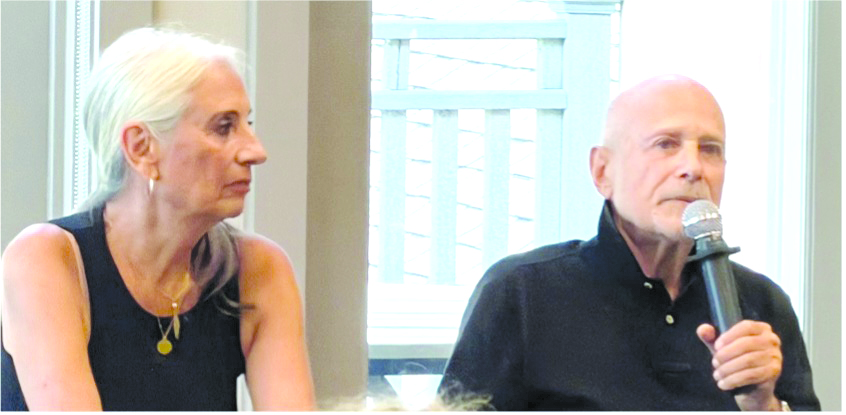
Barry and Barbara Rosen address addressed participants in a presentation at the Woodridge Lake clubhouse in Goshen, August 16/Photo by John Sahlman
On November 4, 1979, Barry was a press attaché in the US embassy in Tehran, one of 52 Americans taken hostage by the Iranian regime that day. He spent the next 444 days in captivity, 14½ months, until his release on January 20, 1981, Ronald Reagan’s inauguration day.
He traces the roots of the 1979 Islamic revolution to 1951, when Iran’s democratically elected Prime Minister, Mohammed Mossadegh, nationalized the oil industry in Iran. According to Rosen, “…the United States, caught up in the Cold War, saw Mosaddegh as a problem in terms of, that is, Iran might turn into a Soviet adjunct or a republic of some sort. So, what eventually occurred is that Mossadegh was overthrown. And that incident… caused a great deal of consternation amongst the Iranian people…” Rosen said that the Shah of Iran, who succeeded Mossadegh, “progressively became a dictator… and made life miserable for most of Iranians.“
He blames a decision by the Carter administration, 9 months after the Islamic revolution, to grant admission to the deposed Shah to the US for cancer treatment, for sparking the storming of the US Embassy in Teheran and his being taken hostage. Rosen said he had written to the State Department beforehand, advising them that admitting the Shah would be a mistake, a warning that went unheeded for reasons Rosen described as political.
Rosen described the ordeal he endured after being taken hostage: “From that time on, those 14 and a half months were an oddity where I was tied up, blindfolded, and I was sitting in a chair for weeks on end, from one day to the next,” he said. “Rather hopeless in the sense that I didn't know, no one knew, what would happen to us. I can honestly say that those first two weeks were the most difficult moments in my captivity because I didn't know if I would be taken out and shot. And the threats were constant day in and day out.”
Barbara Rosen elaborated: “When Barry talks about, well, people ask sometimes, were the hostages tortured? And when he said that he sat in a chair, it was over a month. Everybody in the embassy was in a room tied up and blindfolded… and force-fed and not allowed to talk. Imagine that. Close your eyes and just imagine what it would be like day in and day out for a prolonged period of time to be so sensory deprived. Not having any control over anything. You have to raise your hand if you want to go out and use the bathroom. You ate whatever they put in your mouth. They would not take the blindfolds off.”
“If that's not torture, then I don't know what torture means,” she continued. “It's not having your nails pulled out. It's having no hope and no understanding of how long this is going to last and if you're going to even survive it or does anybody even know, which is the real meaning of being a hostage, does anybody even know that I'm here? And other than my family, does anybody really care?”
When the hostages were eventually released, they were flown first to Algeria and then on to the US military base in Wiesbaden, Germany. “We landed in Wiesbaden, and you have to give President Carter a lot of credit,” Barry said. “He was no longer President. But he flew to Wiesbaden and he spoke to all of us and there were many of my colleagues who were absolutely really angry at him, angry at the United States… I gave him credit for the amount of hate that was spewed toward him by many of my colleagues… He stood up, and I really felt honored that he took the opportunity... He didn't have to do it, but he did do it. He came and he accepted the pain from many of us.”
Barbara talked about the outpouring of support the hostages received from the American people. “I have never experienced the amount of love and support from the public that we had during those 444 days and then afterwards when he came home. We stopped when we first got back to New York City, first off the plane. The captain knew that we were on the plane and he did a circle around the Empire State Building so that Barry could take a look at the city just before we landed.
We were picked up by a car. We had a police escort. And I said to Barry, St. Patrick's was having an ecumenical service. They had had a service while they were held hostage that I had gone to and they were having a service of Thanksgiving that day. So I said, I think we should stop at the church, at the Cathedral. So we went to St. Patrick's. Barry was pulled up onto the altar. And the entire congregation, everybody there, stood up and applauded. I had never in my life seen anything like that.
He felt that we should also go and we stopped at, I think it was Temple Emmanuel... This way we were thanking everybody. We stopped at a construction site where the construction workers had put up a sign every single day, how many days the hostages were held. They took us up into the building. They gave him an honorary hard hat. The parade, the New York City parade, honoring the hostages was absolutely unbelievable.”
When he returned home, Rosen faced a difficult reintegration into normal life. “It took a very long time in terms of dealing with my children. My youngest was…two years old, and my eldest was four… And I was a stranger. I was a total stranger in the house. And Mom was the leader of the pack. And I more or less felt out of place.”
Rosen said that what eventually helped him connect with his children was baseball.
Among the gifts bestowed on the hostages upon their return was a lifetime free pass from Major League Baseball. “So I could go to any city, anywhere, and so we would get in the car and drive. And that was the real connecting force between all of us as a family… Barbara was good. Barbara was really the one who gave me the space to be with the children as much as I possibly could.”
“There was no trust,” Barbara confirmed. “And it was with those baseball games that I said, I'm not going, I don't like baseball. So if the kids wanted to go, they had to go with Dad. And they went, religiously. They went, you know, sometimes twice a week. They'd just get in the car and go. And watch a game. And that really helped to heal the relationship.”
The Goshen News later asked Rosen which team he had supported, quipping that it was hopefully not The Mets, as that might brand him as a glutton for punishment. “Yes. But that's okay. From Brooklyn. Got to be the Mets”, he answered.
Rosen is now a member of the Executive Board of Hostage Aid Worldwide. According to the organization’s website, “Hostage Aid Worldwide is a nonprofit organization dedicated to researching and studying hostage-taking and unlawful detention. We maintain the most comprehensive global database of publicly reported hostage and detainee cases and conduct ongoing basic and applied research to analyze trends in arrests, releases, negotiations, and outcomes. Our team—including staff researchers, fellows, and interns—produces data-driven insights that inform policy, support advocacy, and shape international responses.”
“As a hostage, it never goes away,” Rosen said. “It's part, parcel of your life. And I think because of that, I've spent these many years attempting to try to free hostages.”